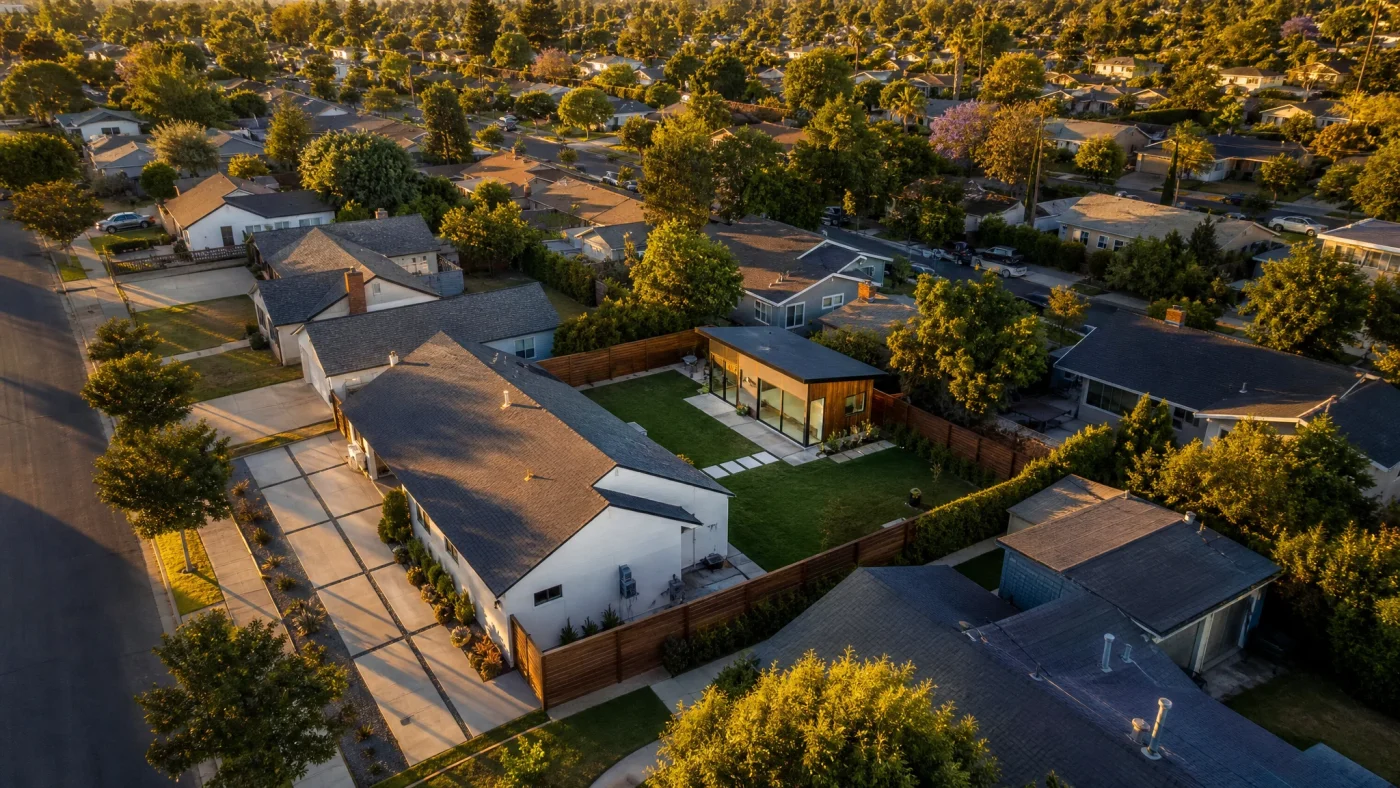
Quick Answer: What Are the Top Benefits of an ADU?
The primary benefits of adu construction include generating predictable monthly rental income ($1,200 to $3,200 per month), adding 20% to 35% in overall property equity, creating flexible housing for aging parents or adult children that avoids $65,000+ per year in assisted living costs, and unlocking valuable IRS tax shelters through 27.5-year property depreciation. Because homeowners build on land they already own, an accessory dwelling unit produces cash-on-cash returns between 8.5% and 11.5%, outperforming almost all traditional residential real estate investments.
Across California, Texas, the Pacific Northwest, and Florida, property owners are transforming underutilized backyard space into high-yield, flexible housing assets. An Accessory Dwelling Unit (ADU), whether built as a detached backyard cottage, an attached suite, or a converted garage, delivers a unique combination of financial, practical, and personal advantages.
Unlike traditional real estate investing, which requires purchasing expensive land and paying steep interest on separate parcels, building an ADU allows you to build on equity you already hold. Below, we break down the 7 most powerful benefits of an ADU and explain how homeowners maximize long-term wealth through smart backyard development.
In This Guide
- 1. Predictable Monthly Passive Income
- 2. Immediate Property Value and Equity Growth
- 3. Affordable Multigenerational Living and Senior Care
- 4. Flexible Downsizing and Aging in Place
- 5. Significant IRS Tax Shelters and Depreciation
- 6. High Return on Investment with Zero Land Cost
- 7. Eco-Friendly Footprint and Sustainable Urban Living
- How to Maximize Your ADU Project with Build With A Plan
- Frequently Asked Questions
1. Predictable Monthly Passive Income
The most immediate benefit of an ADU is recurring monthly cash flow. With rental vacancies remaining near historic lows in high-demand residential neighborhoods, quality backyard rentals command premium rents from young professionals, graduate students, remote workers, and traveling healthcare personnel.
Depending on your metropolitan area and the unit size, a permitted secondary dwelling produces substantial rental revenue:
- Studio ADUs (350 to 450 sq ft): Earn between $1,100 and $1,800 per month.
- 1-Bedroom ADUs (500 to 650 sq ft): Generate $1,600 to $2,400 per month.
- 2-Bedroom ADUs (750 to 1,000 sq ft): Command $2,200 to $3,200+ per month in high-cost metros like Los Angeles, San Diego, and Seattle.
Because the unit sits directly on your residential lot, property management is straightforward. Routine maintenance inspections, landscape care, and minor repairs require no travel across town, reducing operational overhead to near zero.
2. Immediate Property Value and Equity Growth
Building a permitted secondary dwelling permanently increases the gross living area (GLA) of your real estate parcel. In modern appraisal methodology, appraisers evaluate an ADU using two distinct techniques:
- The Contributory Value Approach: Adding the square footage value of permitted finished living area based on regional comparable sales.
- The Income Capitalization Approach: Assessing the net operating income (NOI) generated by the tenant lease.
Recent appraisal data across major housing markets confirms that every dollar spent building a permitted detached cottage adds between $1.00 and $1.35 in immediate appraised property equity. On a $180,000 construction investment, homeowners regularly realize a property value increase of $200,000 to $250,000 upon final inspection sign-off.
Furthermore, when Fannie Mae and Freddie Mac updated underwriting standards, lenders gained the authority to count 75% of projected ADU rental income toward mortgage qualification on future home purchases or cash-out refinances, expanding your personal borrowing capacity.
3. Affordable Multigenerational Living and Senior Care
Beyond financial metrics, the emotional and family benefits of an ADU are unmatched. Millions of American families face the daunting cost of assisted living facilities, which nationwide now average $5,300 to $7,500 per month ($63,600 to $90,000+ per year) according to national care surveys.
An ADU provides an ideal multigenerational solution:
| Housing Option | Typical Annual Cost | Privacy Level | Long-Term Equity |
|---|---|---|---|
| Private Assisted Living Facility | $65,000 to $92,000 per year | Low (shared corridors/dining) | $0 (100% sunk expense) |
| Standard Nursing Home Private Room | $108,000 to $130,000 per year | Institutional | $0 (100% sunk expense) |
| Backyard ADU Cottage (Financed) | $16,000 to $22,000 per year | High (private home on family lot) | Homeowner builds 100% equity |
Building a private, barrier-free single-story granny flat on your lot keeps elderly parents close for daily meals, social interaction, and medical monitoring while preserving complete autonomy and privacy for both households. Instead of watching retirement savings dissolve into commercial facility fees, family resources remain invested in family-owned real estate.
Likewise, adult children graduating from college or saving for their own first home down payment can live in the secondary suite rent-free or at below-market rates, insulating them from exorbitant regional rental spikes.
4. Flexible Downsizing and Aging in Place
Homeowners nearing retirement frequently encounter a dilemma: their primary home is too large to maintain, heating bills and property taxes are burdensome, but they love their neighborhood and refuse to leave their established community.
An ADU introduces a lifestyle transition known as "reverse downsizing":
- The retiring homeowners build a custom, modern, single-story ADU in their backyard equipped with universal design principles: curbless showers, wide doorways, zero-step entries, and low-maintenance smart appliances.
- The homeowners move into the brand-new, energy-efficient backyard cottage.
- They rent out the large primary main house to a long-term family tenant for $3,500 to $5,500 per month.
This transition enables homeowners to age in place gracefully in their beloved neighborhood while their former primary residence generates enough rental income to fully fund their retirement lifestyle.
5. Significant IRS Tax Shelters and Depreciation
Operating an accessory dwelling unit as a residential rental property unlocks extensive federal and state tax advantages under IRS Publication 527.
Key Tax Advantages:
- 27.5-Year Straight-Line Depreciation: You can depreciate the entire construction cost of the secondary dwelling over 27.5 years. On a $180,000 build, this creates an annual non-cash tax deduction of $6,545 each year. This paper write-off offsets your collected rental income, allowing thousands of rental dollars to hit your bank account tax-free.
- Pro-Rata Utility & Maintenance Deductions: Landscaping expenses, roof repairs, private security systems, pest control, and shared utility improvements become partially or fully deductible against rental earnings.
- Mortgage Interest & Insurance Deductions: The interest on any home equity line of credit (HELOC) or construction financing utilized to build the unit is tax-deductible to the extent the capital was spent on income-producing improvements.
Always consult a certified CPA or tax professional to calculate your exact deductions and establish separate accounting ledgers for the unit.
6. High Return on Investment with Zero Land Cost
In traditional commercial or residential real estate development, raw land acquisition represents 25% to 45% of total capital expenditure. When purchasing an off-site rental duplex or condo, you pay for the land, HOA fees, master insurance policies, and developer profit margins.
With an ADU, your land cost is $0.00.
Because you build on land you already own and maintain, your capital goes directly into high-quality vertical construction. This structural efficiency drives unlevered capitalization rates between 8.5% and 11.5%, compared to 3.5% to 5.5% cap rates for conventional single-family rental homes in metro markets.
Investment Performance Comparison (2026 Benchmarks):
| Investment Vehicle | Typical Capital Required | Average Annual Return / Cap Rate | Passive Management Effort |
|---|---|---|---|
| Stock Market (S&P 500 Historical) | Variable | 7% to 10% (pre-tax) | Completely passive |
| Off-Site Single-Family Rental Home | $120,000 (20% down on $600k) | 4.0% to 5.5% net cap rate | Moderate (remote tenant travel) |
| Off-Site Condominium Rental | $80,000 (20% down + HOA fees) | 3.5% to 4.8% net cap rate | High HOA risk and special assessments |
| Backyard ADU Build | $140,000 to $210,000 total | 8.5% to 11.5% net cap rate | Low (on-site oversight, zero land cost) |
7. Eco-Friendly Footprint and Sustainable Urban Living
Modern accessory dwelling units are among the most sustainable housing typologies in North America:
- Minimal Embodied Carbon: Because ADUs average 400 to 800 square feet, they consume fewer raw construction materials, lumber, insulation, and concrete than standalone subdivisions.
- Ultra-Low Energy Consumption: Compact footprints paired with strict modern energy building codes (such as California Title 24 or Seattle Energy Code) mean ADUs heat and cool with high-efficiency mini-split heat pumps at a fraction of a standard home's utility footprint.
- Combating Urban Sprawl: By adding gentle infill density within established residential zones, ADUs utilize existing municipal water pipes, electrical grids, sewer trunks, and public transit corridors without clearing greenfields or paving over natural wildlife habitats.
How to Maximize Your ADU Project with Build With A Plan
Capturing the maximum benefits of an ADU requires an experienced pre-construction partner who understands local zoning laws, setback exemptions, utility tie-in requirements, and city permitting nuances.
Traditional architecture firms frequently charge $12,000 to $20,000 just to begin conceptual drawings, leaving homeowners vulnerable to permitting delays and budget overruns. Build With A Plan eliminates the guesswork through The Backyard Wealth Package:
"We turn your backyard into a rental unit. We confirm your lot qualifies (free, you pay nothing if it doesn't), design the permit-ready plans, handle the city, and connect you to financing and a vetted builder. $6,000 flat, about what an architect charges just to start."
Every project is backed by our written deliverables guarantee:
"Your construction documents will be permit-ready and accepted for submission by your city, or we revise them free until they are. And if your property doesn't pass our free feasibility check, you pay nothing."
We verify your zoning, utility easements, and building envelope before you spend a penny. Check our pricing guide or discover whether your lot is eligible with our free feasibility check.
Unlock Your Property's Full Potential
See What an ADU Can Do for Your Finances and Family
Run a free zoning and feasibility assessment on your parcel. We verify your lot size, setbacks, utility lines, and rental potential before you spend a single dollar.
Run Your Free Feasibility CheckFrequently Asked Questions
Will building an ADU trigger a full property tax reassessment?
No. In states like California (under Proposition 13 guidelines), adding an ADU does not trigger a reassessment of your existing primary home or existing land parcel. Only the new value of the newly constructed secondary structure is assessed and added to your annual tax bill as an incremental line item.
How long does it take for an ADU to pay for itself?
Most homeowners achieve complete payback within 6 to 9 years based on net rental income. When factoring in immediate equity appreciation and federal depreciation tax write-offs, the effective financial breakeven often occurs within 24 to 36 months of occupancy.
Can I build an ADU if my property is governed by an HOA?
In California and several other progressive housing states, state statutes explicitly prevent HOAs from prohibiting or unreasonably restricting the construction of permitted accessory dwelling units on single-family lots. While HOAs can enforce reasonable architectural aesthetics (such as matching paint or roof shingles), they cannot block your right to build.
Is an attached ADU or a detached ADU more beneficial?
Detached ADUs provide greater privacy, command 15% to 25% higher monthly rents, and cause zero disturbance to the main house during construction. Attached ADUs or garage conversions cost less to build upfront and require less open yard space, making them ideal for smaller urban lots with strict setback requirements.