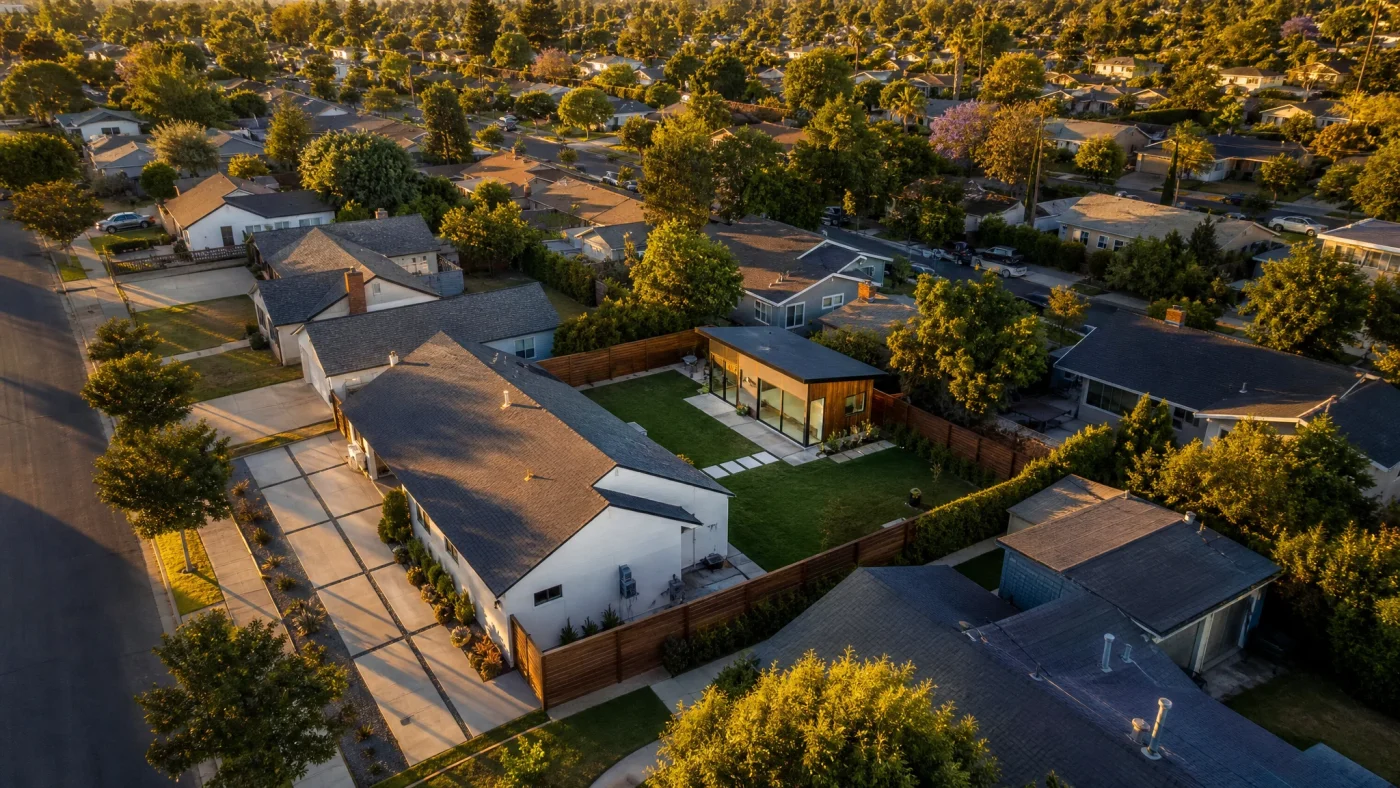
Quick Answer: Can an HOA Stop an ADU?
When homeowners ask can hoa stop adu construction, the answer depends entirely on the state. In California (Civil Code § 4751), Washington (RCW 64.38.058), and Colorado (HB 24-1152), state laws explicitly declare that any HOA covenant, deed restriction, or CC&R provision that bans or effectively prohibits the construction of an ADU is void and legally unenforceable. In those states, an HOA can only impose "reasonable objective design standards" that do not significantly increase construction costs or delay your build. Conversely, in Texas and Florida, private subdivision deed restrictions still have full legal force and can prohibit second residential kitchens or detached rental units.
In This Guide
- State-by-State Breakdown: Where State Law Overrides Your HOA
- What "Reasonable Design Standards" Mean for HOA Approval
- How Texas and Florida Treat Subdivision Deed Restrictions
- How to Submit an ADU to Your HOA Architectural Review Committee
- What to Do If Your HOA Illegally Rejects Your ADU Application
- Frequently Asked Questions
1. State-by-State Breakdown: Where State Law Overrides Your HOA
More than 75 million Americans live in common-interest communities governed by a Homeowners Association (HOA), condominium board, or community association. If you own a home in an HOA-governed neighborhood, the question of whether an HOA can stop you from building a backyard ADU depends entirely on your state legislature:
California: Total Preemption Under AB 670 and AB 3182
Under California Civil Code Section 4751 (enacted via Assembly Bill 670 and expanded by AB 3182):
- Any covenant, condition, or restriction (CC&R) or governing rule that effectively prohibits or unreasonably restricts the construction or use of an Accessory Dwelling Unit or Junior ADU on a single-family residential parcel is null, void, and unenforceable.
- An HOA board cannot forbid you from building a detached backyard cottage, converting your garage into an apartment, or renting the ADU out to a long-term tenant.
- While the HOA can enforce reasonable aesthetic guidelines, the law states that any rule that increases the cost of construction or unreasonably delays the process is prohibited.
Washington State: Preemption Under HB 1337
Under Revised Code of Washington (RCW) 64.38.058 and RCW 64.90.585:
- For common-interest communities and HOAs, covenants cannot restrict the construction of up to two accessory dwelling units per single-family lot within urban growth areas.
- Older associations with pre-existing restrictions cannot enforce bans against homeowners who build code-compliant units under updated GMA comprehensive plans.
Colorado: Preemption Under HB 24-1152
Under Colorado House Bill 24-1152, common-interest communities are broadly restricted from barring accessory dwelling units in designated subject jurisdictions across the Front Range (including Denver and surrounding metros). HOAs must permit ADUs subject only to objective standards that mirror municipal building codes.
Texas and Florida: Private Deed Restrictions Remain King
In Texas and Florida, the legal framework is completely reversed:
- Neither state has passed a statutory preemption overriding private HOA deed restrictions.
- In Texas, Chapter 202 and 209 of the Texas Property Code allow HOA boards and civic associations to strictly enforce recorded covenants that prohibit secondary dwelling units, detached living quarters, or rental structures.
- In Houston, which has no municipal zoning code, city plan reviewers require applicants to sign a notarized Deed Restriction Affidavit confirming that their subdivision covenants do not forbid an ADU.
2. What "Reasonable Design Standards" Mean for HOA Approval
In states where HOAs cannot ban ADUs (like California and Washington), associations still hold the legal right to enforce "reasonable objective design standards."
Understanding the legal line between an enforceable design requirement and an illegal restriction protects you from unnecessary delays:
| What an HOA CAN Legally Require | What an HOA CANNOT Require (Illegal Restriction) |
|---|---|
| Matching exterior paint colors to the primary residence | Requiring the ADU to be built of expensive stone or brick that doubles framing costs |
| Matching roof pitch, shingles, or exterior trim details | Requiring a 2-story house to build only an interior basement conversion |
| Reasonable privacy screening (fencing or landscaping shrubs) along neighboring property lines | Imposing setbacks larger than the state-mandated 4-foot side and rear setbacks |
| Obscured or clerestory second-story windows facing direct neighbor bedroom sightlines | Demanding off-street parking spots that state law explicitly exempts |
| Reasonable trash and utility conduit screening | Imposing thousands of dollars in arbitrary association "impact fees" or approval deposits |
Under California case law, if an HOA requirement adds significant cost or makes building the ADU financially unfeasible, that requirement violates Civil Code Section 4751 and will not hold up in court.
3. How Texas and Florida Treat Subdivision Deed Restrictions
If you live in Texas or Florida, checking your property title before ordering architectural plans is critical:
- Obtain Your Recorded Plat and CC&R Document: When you purchased your home, your title insurance policy included an exhibit listing recorded easements and covenants. You can also download your subdivision plat from your county clerk or recorder of deeds website.
- Key Clauses to Search For:
- "Single-family occupancy only" (does the covenant define single-family as related by blood, or does it restrict the parcel to one single kitchen?).
- "No detached outbuilding shall be used for residential or living purposes."
- "No garage shall be enclosed or converted into living space unless a replacement enclosed garage is constructed simultaneously."
- Subdivision Age and Expiration Clauses: Many older Texas and Florida subdivisions (established in the 1960s to 1980s) contained 25- or 30-year deed restrictions with automatic sunset clauses that were never formally renewed by a majority vote of homeowners. An experienced real estate attorney can verify whether your restriction is still legally active.
4. How to Submit an ADU to Your HOA Architectural Review Committee
To breeze through your HOA's Architectural Review Committee (ARC) without friction, follow this proven submittal sequence:
- Step 1: Request the HOA Design Guidelines Packet Early: Download the architectural guidelines from your community portal so our architectural drafting team knows the preferred roof tile, siding texture, and trim colors.
- Step 2: Submit a Complete Professional Plan Set: Volunteer ARC boards are easily confused by rough hand sketches. Submitting a clear, fully dimensioned architectural set (site plan showing setbacks, roof elevations, color chips, and exterior material specifications) demonstrates that the addition will look like a seamless, high-end extension of the property.
- Step 3: Track the Statutory Review Deadline: Most state HOA acts and CC&Rs enforce strict review timelines (typically 30 to 45 days). In many jurisdictions, if an HOA fails to provide written approval or denial with specific reasons within the statutory window, the application is deemed approved automatically.
5. What to Do If Your HOA Illegally Rejects Your ADU Application
If your property is in California, Washington, or Colorado and an HOA board attempts to reject your ADU:
- Cite the Statutory Code in Writing: Send a polite, formal response referencing the state statute (for example: "Under California Civil Code Section 4751, HOA covenants restricting ADUs are void. We request that the committee identify specific objective aesthetic guidelines that comply with state law.").
- Remind the Board of Attorney's Fees Provisions: In California, Civil Code Section 4751 specifically provides that a homeowner who prevails in legal action against an HOA for unlawfully blocking an ADU is entitled to mandatory recovery of reasonable attorney's fees. When association legal counsel reviews this clause, boards almost always reverse course and issue approval.
How the Backyard Wealth Package Simplifies HOA Approvals
You should not have to spend weekends arguing with an HOA board or decoding local bylaws alone. Build With A Plan handles custom design, municipal code alignment, and neighborhood plan packages through The Backyard Wealth Package:
"We turn your backyard into a rental unit. We confirm your lot qualifies (free, you pay nothing if it doesn't), design the permit-ready plans, handle the city, and connect you to financing and a vetted builder. $6,000 flat, about what an architect charges just to start."
Every homeowner is protected by our written deliverables commitment:
"Your construction documents will be permit-ready and accepted for submission by your city, or we revise them free until they are. And if your property doesn't pass our free feasibility check, you pay nothing."
We won't even take your money unless your property qualifies. Explore how it works or verify your property with our free feasibility check.
Free HOA & Zoning Review
Check If Your Lot and HOA Qualify for an ADU
Enter your property address to confirm your state's HOA preemption laws, setbacks, allowable square footage, and build budget for free. We won't even take your money unless your property qualifies.
Run Your Free Feasibility Check6. Frequently Asked Questions
Can an HOA charge me an extra monthly assessment if I build an ADU?
In California, Washington, and Colorado, HOAs are prohibited from levying arbitrary special assessments or increasing regular monthly association dues solely because a homeowner added an accessory dwelling unit, unless the association incurs direct, documented common-area utility costs (such as a shared master water meter where the HOA pays the water bill).
Can an HOA prohibit my ADU tenant from using community amenities like the pool?
No. An ADU tenant is a legal resident of the property. Under state tenant rights and HOA fair housing laws, tenants hold the same right to access common elements (neighborhood pool, parks, fitness center) as any primary home resident.
Can an HOA restrict short-term rentals (Airbnb) in an ADU?
Yes. Even in states like California where HOAs cannot ban ADUs or long-term rentals (leases over 30 days), an HOA has the full legal power to prohibit short-term rentals under 30 days if your CC&Rs contain a general ban on commercial transient occupancy.
Should I get city permit approval before or after HOA approval?
In practice, you can run them simultaneously. Most homeowners submit their plans to the city building department for plan check while submitting the same architectural package to their HOA Architectural Review Committee. In California, cities will issue building permits regardless of HOA status, but getting your HOA sign-off before construction starts prevents post-construction disputes.