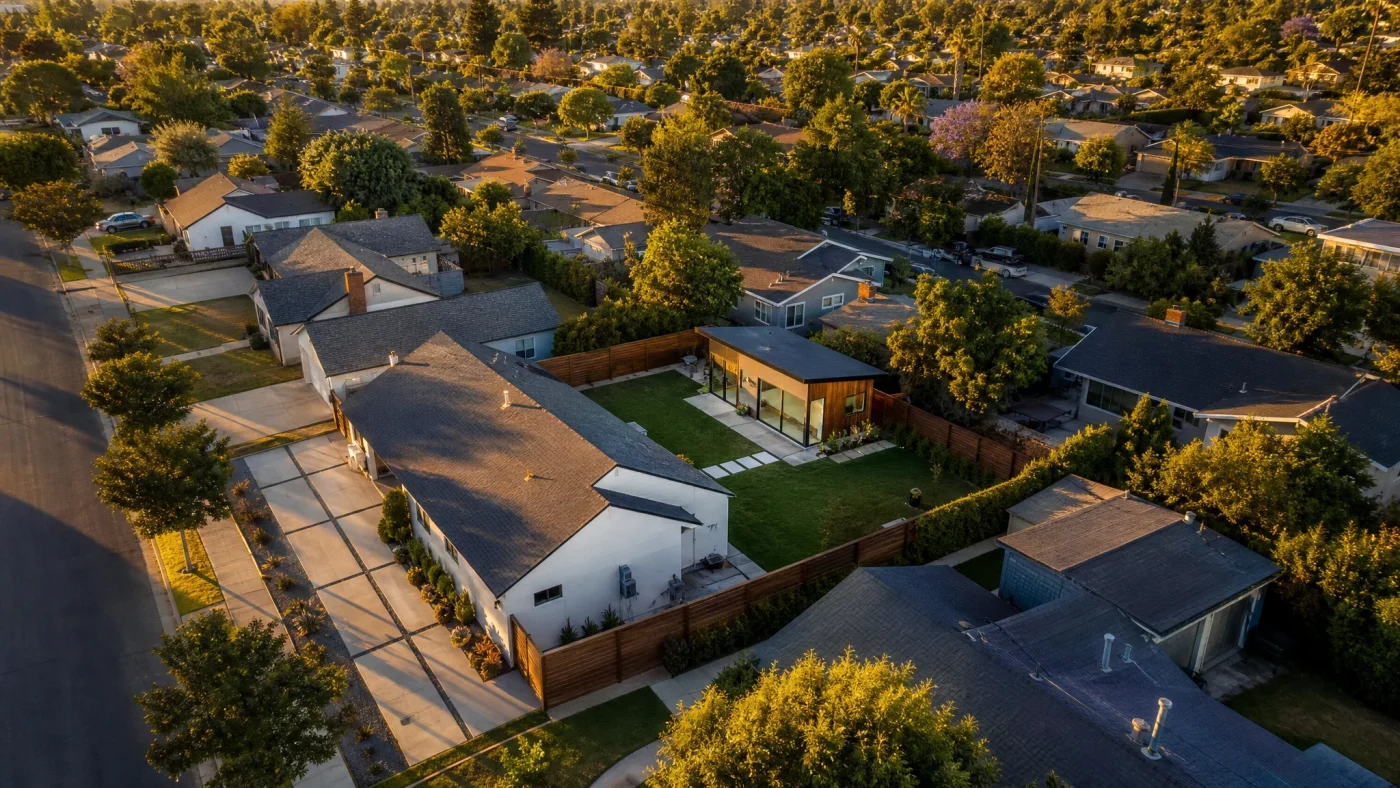
Self-employed homeowners hit a wall the moment they ask a bank about ADU financing: no W-2, no simple debt-to-income math, and loan officers who don't know what to do with 1099 income or business deposits. This guide breaks down which financing structures actually work for self-employed borrowers building an accessory dwelling unit in 2026, and which ones waste your time.
- DSCR loans qualify self-employed borrowers on projected ADU rent, not personal income — the strongest fit for adu financing for self-employed applicants in 2026.
- Bank statement loans replace tax returns with 12-24 months of deposits — Buy for freelancers with strong cash flow.
- Standard construction loans requiring two years of tax returns are a Skip for anyone who writes off income aggressively.
- HELOCs work as a fast starter but carry variable rates that can move during a multi-month permit timeline.
Why this matters
A W-2 employee walks into a bank with two pay stubs and gets a debt-to-income ratio in five minutes. A self-employed homeowner with a strong business and solid deposits can get denied for the exact same loan amount because underwriters default to the lowest two-year average of net income shown on Schedule C. That gap is the entire reason ADU financing for self-employed borrowers needs a different playbook than the standard home equity conversation.
Getting the financing wrong doesn't just cost you a rejected application. It costs you months, because most lenders won't re-underwrite mid-permit, and a stalled construction loan can leave a half-built ADU sitting through a rainy season. Build With A Plan runs a free AI feasibility check before any design work starts, so you know whether your lot can legally hold an ADU before you commit to a financing structure at all.
Who this is for
This breakdown is built for 1099 contractors, freelancers, small business owners, and gig-economy homeowners who want to convert a garage or build a detached ADU for rental income but don't have a traditional paycheck to show a lender. If your last two tax returns show declining or inconsistent net income because you maximize deductions, standard mortgage math will undersell what you actually earn.
What to look for in ADU financing for self-employed borrowers
Income documentation flexibility
Standard mortgage underwriting averages your last two years of net income after deductions, which punishes self-employed borrowers who write off aggressively. Bank statement programs and asset-based underwriting look at deposits instead of tax returns, which is usually a more honest picture of what a business owner actually brings in.
Ability to count projected rental income
Most self-employed applicants have decent cash flow but a debt-to-income ratio that's already tight from business expenses. A lender that lets you count the ADU's projected rent toward qualifying — before it's even built — changes the math entirely.
Draw schedule matched to permit milestones
Construction financing releases money in stages tied to inspections: foundation, framing, rough-in, final. If your permit timeline slips (and in 2026, plan review backlogs in several counties still run 6-10 weeks), you need a lender whose draw schedule doesn't penalize you for delays outside your control.
Rate structure and lock timing
A HELOC's variable rate can move meaningfully over a 4-8 month build. A fixed-rate cash-out refinance locks your cost but resets your entire first mortgage. Know which trade-off you're accepting before you sign, not after the first rate adjustment notice.
Closing speed relative to your design timeline
If your permit-ready plans are done in 10 days but your loan takes 45 to close, you're sitting on a design fee with no financing behind it. Match your lender's closing timeline to your actual permit and design schedule instead of assuming they'll align.
Top financing picks for self-employed ADU borrowers
DSCR loan — the income-first pick
Debt Service Coverage Ratio loans qualify you on the property's projected rental income instead of your personal tax returns. Lenders typically want the projected rent to cover 1.0x to 1.25x the new debt payment, and they don't ask for a single pay stub or Schedule C. For a self-employed homeowner whose personal income looks lower on paper than it actually is, this is the cleanest path. Verdict: Buy if you can document projected rent with a comparable-rental analysis.
Bank statement loan — the self-employed unlock
Instead of two years of tax returns, these programs qualify you on 12 to 24 months of personal or business bank deposits. Rates typically run higher than a conventional loan, but approval odds are far better for anyone whose write-offs make their taxable income look thin. Verdict: Buy for freelancers and business owners with consistent, provable cash flow.
HELOC — the fast starter
A home equity line of credit draws against your existing equity with a variable rate, and most lenders close it faster than a construction loan. It's a reasonable way to fund permit fees, design costs, and early-stage construction draws while a larger loan is still in underwriting. Verdict: Consider as a bridge, not as your only financing source for a full build.
Cash-out refinance — the low-rate workhorse
If you have significant equity and current mortgage rates aren't far off your existing rate, a cash-out refinance can fund the entire ADU build in one lump sum at a fixed rate. The catch: you're resetting the term and rate on your entire first mortgage, not just the new construction amount. Verdict: Consider only if the blended rate math actually works in your favor.
Construction-to-permanent loan — the builder's loan
These convert automatically from a construction draw schedule into a standard mortgage once the ADU is finished, avoiding a second closing. Self-employed borrowers often struggle here because many lenders still require two years of tax returns to qualify for the conversion phase. Verdict: Skip unless your lender explicitly offers bank-statement or asset-based underwriting for the permanent phase too.
What to avoid
- Unsecured personal loans marketed as "ADU loans." They carry rates well above secured home equity products and cap out too low to cover a full build.
- Any construction loan that requires two years of unmodified tax returns if your net income has declined due to deductions rather than actual business performance — you'll qualify for less than your real cash flow supports.
- Variable-rate financing with no rate cap for a build timeline longer than 6 months. A jump of even 1.5 points mid-construction can blow a tight budget.
A garage-to-ADU conversion is usually cheaper to finance than ground-up construction because you're not paying for a new foundation, which matters if your loan amount is the deciding factor in approval.
“You pay nothing if the lot doesn't qualify — NOT-VIABLE means we don't pitch.”
Comparison table
| Financing option | Documentation needed | Rate type | Best for | Verdict |
|---|---|---|---|---|
| DSCR loan | Rent projection, no tax returns | Fixed or ARM | Projected-rent-heavy budgets | Buy |
| Bank statement loan | 12-24 months deposits | Fixed | Strong cash flow, thin taxable income | Buy |
| HELOC | Standard equity docs | Variable | Bridge funding, early draws | Consider |
| Cash-out refinance | Standard equity docs | Fixed | Large equity, favorable blended rate | Consider |
| Construction-to-perm | Two years tax returns (most lenders) | Fixed after conversion | W-2 or documented steady self-employed income | Skip for most 1099 borrowers |
Check if your lot qualifies first
Free AI feasibility check before you commit to any financing structure.
FAQ
What is the best ADU financing for self-employed homeowners in 2026?
DSCR loans and bank statement loans are the strongest fits for 2026 because both qualify you on cash flow or projected rent instead of two years of tax returns. Standard construction loans still favor W-2 borrowers with steady documented income.
Can I use projected rental income to qualify for an ADU loan?
Yes, DSCR loan programs let you count the ADU's projected rent toward qualifying instead of your personal income. Lenders typically want that projected rent to cover 1.0x to 1.25x the new monthly payment.
Is a HELOC or a cash-out refinance better for self-employed ADU borrowers?
A HELOC closes faster and works well for early-stage costs like permits and design, while a cash-out refinance locks a fixed rate for the full build. Choose the refinance only if the new blended rate on your whole mortgage still beats your current rate.
Do I need two years of tax returns to get ADU financing?
Most conventional construction loans still ask for two years of tax returns, which hurts self-employed borrowers who write off aggressively. Bank statement and DSCR programs skip tax returns entirely and rely on deposits or projected rent instead.
How much does ADU financing cost compared to the design and permit process?
Financing costs vary by lender and loan type, but the design and permitting phase is a separate line item — Build With A Plan charges a flat $6,000 for permit-ready design work regardless of which financing option you choose.
What documents do bank statement loans require?
Bank statement loans typically require 12 to 24 months of personal or business bank statements instead of tax returns. Lenders average the deposits to estimate qualifying income.
Does a garage conversion cost less to finance than a new detached ADU?
Yes, garage conversions usually require a smaller loan amount because the existing foundation and structure cut out the largest construction costs. That smaller loan amount also makes qualifying easier for self-employed borrowers with tighter debt-to-income ratios.
What happens if my ADU permit gets delayed after I've already closed on financing?
Construction loans with draw schedules tied to inspection milestones don't penalize you for permit delays, since draws simply release later. This is why matching your lender's draw structure to your county's actual permit timeline matters before you sign.
One last thing
The self-employed borrowers who get denied most often aren't the ones with low income — they're the ones who assumed a lender would look at their business the way their accountant does. A lender sees Schedule C after deductions; your accountant sees cash flow before them. Ask upfront whether the program underwrites on deposits, projected rent, or net taxable income, because that one question determines whether your 2026 ADU project gets approved on the first pass or the third.