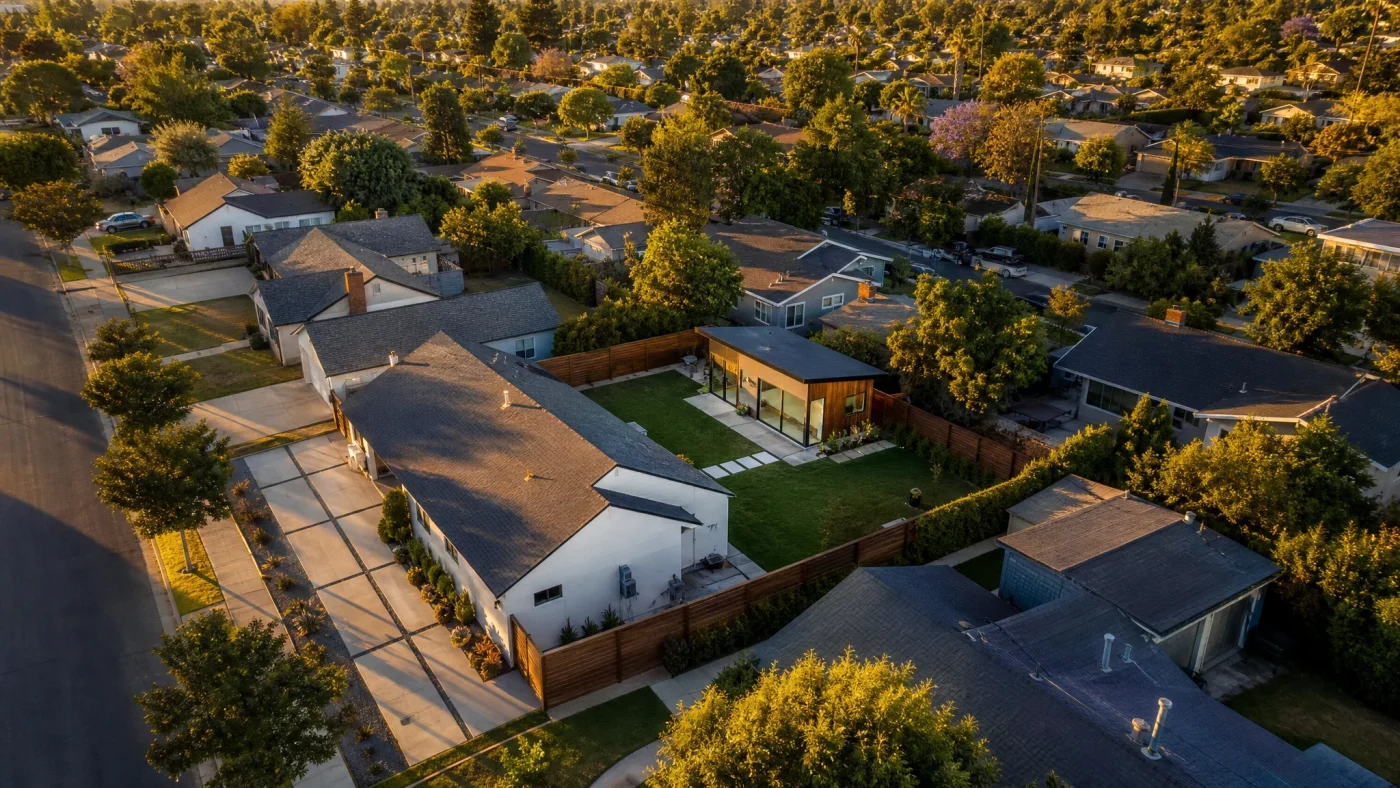
Building an ADU typically does increase your adu property tax, but not the way most homeowners fear. In nearly every state, an accessory dwelling unit gets treated as "new construction" for tax purposes, which means the added value of the unit itself gets assessed and taxed. Your existing home, the one you have been paying taxes on for years, usually keeps its current assessed value untouched. The confusion homeowners run into is that the actual mechanics, the caps, and the relief programs vary wildly depending on which of Build With A Plan's seven states you are building in.
Below is the general rule everyone shares, then the state-by-state differences, because "it depends on your state" is not a satisfying answer when you are trying to budget for a backyard unit. Nobody has ever opened a tax bill and thought "finally, some suspense," so let us get you an actual number instead.
ADU Property Tax At a Glance
7 States
Different ADU property tax rules across our footprint
10 Years
Max CA deferral on new ADU value under SB 1164
30% or Less
WA improvement-value threshold for a 3-year tax exemption
10 Business Days
To get permit-ready plans started
In This Guide
- What Actually Triggers a Property Tax Increase
- The General Rule: New Construction, Not a Full Reassessment
- Property Taxes on an ADU, State by State
- Ways to Reduce the Tax Hit
- Permits and the Path to Breaking Ground
- How to Get Started
- Frequently Asked Questions
What Actually Triggers a Property Tax Increase
Assessors do not drive by your house looking for backyard construction out of curiosity. The trigger is almost always the building permit. Pull a permit for an ADU, and your local assessor's office gets a copy or a record of it, which flags the property for a future review. Additions and new structures that expand livable square footage, an ADU included, typically get reassessed. Cosmetic work, like a new roof, fresh paint, or replaced flooring, typically does not.
Here is the part that surprises people who think skipping the permit avoids the tax: it usually just delays it, badly. Unpermitted construction still shows up on aerial imagery, during a resale, or when a neighbor complains, and when it does, counties can apply the reassessment retroactively along with penalties. Compare that to a legal permit, which triggers the tax increase everyone here is trying to understand, on a schedule you can actually plan around. The permit is not the problem. It is the thing that makes the tax bill predictable instead of a surprise letter three years from now.
The General Rule: New Construction, Not a Full Reassessment
Every state in Build With A Plan's footprint shares one core mechanic, even though the details diverge from there: an ADU counts as "new construction," and new construction typically gets its own assessed value added on top of your existing home's assessment, rather than triggering a fresh, full-property reassessment at today's market value. That distinction matters a great deal in states with long-held homes, where the existing structure's assessed value can sit far below current market value thanks to a growth cap built up over years.
What differs by state is three things: how fast that existing cap grows each year, whether the new ADU value gets folded in immediately at full market value or gradually, and whether the state offers any ADU-specific break on top of the general rule. That is the part worth reading state by state, not skimming.
Property Taxes on an ADU, State by State
The table below covers what triggers the increase, the general cap on assessed-value growth, and any ADU-specific relief available in each of Build With A Plan's seven states.
| State | General Assessment Cap | ADU-Specific Relief |
|---|---|---|
| California | Prop 13: existing home stays at its current assessed value; only the ADU's new value is added | SB 1164 lets you defer that added assessment up to 10 years for ADUs completed Jan. 1, 2025 to Jan. 1, 2030 |
| Texas | 10% annual cap on homestead appraised-value growth | None specific to ADUs; new improvements are excluded from the 10% cap and enter at full market value |
| Florida | Save Our Homes: 3% or CPI cap, whichever is lower, on homestead assessed value | Granny Flat Exemption (F.S. 193.703) if the ADU houses a parent or grandparent age 62+ |
| Arizona | 5% annual cap on Limited Property Value (the figure taxes are levied against) | None specific to ADUs; new construction enters near full cash value, then grows under the 5% cap |
| Colorado | Reassessed every 2 years; ~6.8% residential assessment rate (2026, local govt.) after a reduction on the first $700,000 of value | None specific to ADUs; the 2-year cycle delays when the increase shows up |
| Washington | No statewide percentage cap; assessed near market value on a rolling county cycle | RCW 84.36.400: 3-year exemption if the ADU's value is 30% or less of the original home's value (must file before construction) |
| Oregon | Measure 50: 3% annual cap on Maximum Assessed Value for existing improvements | None specific to ADUs; new construction is added as an uncapped "exception" the year it is built |
California
Proposition 13 keeps your home's existing assessed value frozen at roughly its current level, growing only a small amount each year. Building an ADU does not touch that number. Instead, the ADU gets its own "new construction" assessment added on top, and only that added portion is taxed at the current rate. On top of that baseline protection, Senate Bill 1164 lets homeowners defer the ADU's new-construction assessment entirely, for up to 10 years or until the property changes hands or the unit stops being used as housing, whichever happens first. It applies to ADUs completed between January 1, 2025 and January 1, 2030, and you have to notify the county assessor within 30 days of completion and sign an affidavit committing to residential use to claim it.
Texas
Texas has no ADU-specific tax statute. The general homestead protection caps how much your home's appraised value can climb in a given year at 10%, but new improvements, including an ADU, are carved out of that cap entirely. The unit gets added to your appraised value at full market value the January 1 after it is finished, and only then does it join the capped base going forward. Combined with no state income tax, Texas leans on property tax more heavily than most states in our footprint, so budget for the ADU's added value to show up in full the first year, not phased in.
Florida
Florida's Save Our Homes cap works almost identically to Texas in spirit, just with a tighter number: assessed-value growth on a homestead is capped at 3% a year, or the change in the Consumer Price Index if it is lower. New construction, an ADU included, is assessed at full market value as of the January 1 after substantial completion, then falls under that 3% cap in the years after. Florida does offer one relief valve the other states do not: the Granny Flat Exemption, which reduces the ADU's added assessed value, capped at the lesser of the increase itself or 20% of the property's total assessed value, if the unit houses your parent or grandparent aged 62 or older as their permanent residence. It requires a homesteaded main property, a permitted structure, and a filing deadline of March 1.
Arizona
Arizona reassesses every property annually, but taxes are actually levied against a separate figure called the Limited Property Value, not the unrestricted Full Cash Value. LPV growth has been capped at 5% a year since a 2015 ballot measure, which softens the blow on your existing home. That cap, though, does not protect the ADU in its first year: the new unit's value typically enters near full cash value, then grows under the 5% cap afterward, the same "capped later, not capped at entry" pattern you see in Texas and Florida.
Colorado
Colorado reassesses property only every two years, in odd-numbered years, which means an ADU finished mid-cycle will not show up on a tax bill until the next reassessment. When it does, the math is a straightforward formula: your ADU's added market value, multiplied by the residential assessment rate (about 6.8% for local government levies in 2026, after a statutory reduction on the first $700,000 of a property's value), multiplied by your local mill levy. There is no ADU-specific break, but the two-year lag gives you more runway to plan for the bill than states with annual reassessment.
Washington
Washington stands apart from California, Arizona, and Oregon in one important way: it has no statewide percentage cap on how much your assessed value can grow year to year. County assessors value property at or close to true market value on their own rolling revaluation schedule. What Washington does offer is a specific, underused exemption under RCW 84.36.400: any physical improvement to a single-family home, an ADU included, is exempt from taxation for three assessment years after completion, for whatever portion of the improvement's value is 30% or less of the original structure's value. The catch is timing: you must file notice of your intent to build before construction starts, not after, and you cannot claim it more than once in a five-year span.
Oregon
Oregon's Measure 50 caps the Maximum Assessed Value of existing improvements at 3% annual growth, one of the more homeowner-friendly caps in the country for a house you have owned a while. New construction does not get that protection, though. An ADU is treated as an "exception" event, added to your property's Maximum Assessed Value in proportion to its share of the property's real market value in the year it is built, uncapped by the 3% rule that shelters everything else. Unlike California, Florida, or Washington, Oregon currently has no ADU-specific carve-out softening that first-year hit.
Ways to Reduce the Tax Hit
A few threads run through the state-by-state breakdown above worth pulling out on their own, because they are the actual levers you can pull rather than just facts to absorb:
- File before you build, where the state requires it. Washington's RCW 84.36.400 exemption only works if you file notice before construction starts. California's SB 1164 deferral requires notifying the assessor within 30 days after completion. Miss either window and the relief is gone, permanently, no matter how legitimate your ADU is.
- Check for family-occupancy exemptions. Florida's Granny Flat Exemption can wipe out a meaningful chunk of the added assessment if a parent or grandparent will live in the unit. It is easy to miss because it is filed separately from your building permit, with its own March 1 deadline.
- Understand which states delay the hit versus which apply it immediately. Colorado's two-year reassessment cycle and California's up-to-10-year deferral buy you real planning time. Texas, Florida, and Arizona apply the new value at (or near) full market rate the first assessment cycle after completion, so budget for the full increase in year one, not a phase-in.
- Compare the tax increase to the equity and income the unit generates. Our own breakdown of backyard home benefits in our ADU appraisal guide puts the typical value added by a permitted ADU at an estimated 20% to 35% of your home's value, and typical rental income in the thousands per year. A property tax increase in the hundreds to low thousands annually is real money, but it is worth sizing against the asset it is funding, not evaluating in isolation.
Permits and the Path to Breaking Ground
Everything above assumes one thing: a permitted unit. An unpermitted ADU risks the appraisal problems covered in our ADU appraisal guide, and it leaves your tax situation undefined until a county eventually finds it, at which point you get reassessed retroactively with none of the relief programs above available to you. Build With A Plan delivers permit-ready ADU drawings in 10 business days, with a project coordinator responding to questions within 4 business hours, so the assessor notification clock (and any state-specific relief window) starts on a date you control.
See What Your Backyard Actually Qualifies For
We check your address against your city's zoning rules and tell you the size and configuration your lot supports, free. You pay nothing if your property does not qualify.
Check My Property: It's Free →How to Get Started
- Run a free feasibility check. We confirm your lot qualifies before you spend anything. If it does not qualify, you pay nothing.
- Get permit-ready plans. Starting at $997 for self-serve packages, or $6,000 for a fully custom-drawn set with a project coordinator managing your city's permit submission, delivered in 10 business days and backed by a 14-day money-back guarantee.
- Ask about state-specific tax relief early. If you are in California or Washington, the filing windows for the deferral and exemption programs above start relative to your construction timeline, not your tax bill, so it pays to ask before, not after, you break ground. For a market-specific look, explore ADU design in Los Angeles.
None of the seven states above will tax your imagination, only the finished square footage, so there is no tax penalty for over-planning this part. Get the permit right, file the paperwork on time where your state allows it, and the property tax line item becomes a known, budgetable number instead of the vague dread it starts out as.
Frequently Asked Questions
Does building an ADU increase your property taxes?
In nearly every case, yes, but typically only on the added value of the ADU itself. Most states treat an accessory dwelling unit as new construction, which adds its own assessed value on top of your existing home's assessment rather than triggering a full reassessment of the whole property at current market rates.
How much will my property taxes go up after building an ADU?
It depends on your state's assessment rate, your local mill levy or millage, and the ADU's assessed value, which is typically a fraction of its construction cost. There is no single national number: Colorado applies roughly a 6.8% residential assessment rate to the added value before the mill levy, while Texas and Florida add the ADU at full market value the first assessment cycle after completion. Check your state's section above for the specific mechanic that applies to you.
Does California have a property tax break for ADUs?
Yes. Beyond Proposition 13 already protecting your existing home's assessed value, Senate Bill 1164 lets eligible homeowners defer the new-construction assessment on an ADU for up to 10 years, for units completed between January 1, 2025 and January 1, 2030, provided you notify the county assessor within 30 days of completion.
Is there a property tax exemption for an ADU in Washington state?
Yes, under RCW 84.36.400. Physical improvements to a single-family home, including an ADU, are exempt from taxation for three assessment years after completion, for the portion of the improvement's value that is 30% or less of the original structure's value. You must file notice of your intent to build before starting construction, and the exemption cannot be claimed more than once every five years.
Do I have to tell my county assessor about my ADU?
Pulling a building permit typically notifies the assessor's office automatically, which is one of several reasons skipping the permit is a poor shortcut. Some state-specific relief programs, like California's SB 1164 deferral or Washington's RCW 84.36.400 exemption, also require a separate, timed notification directly to the assessor on top of the standard permit process.
Which states have the friendliest property tax treatment for ADUs?
Among Build With A Plan's seven states, California and Washington currently offer the most direct ADU-specific relief, California through the SB 1164 deferral and existing Prop 13 protections, Washington through the RCW 84.36.400 three-year exemption. Florida's Granny Flat Exemption is generous but conditional on a qualifying family member living in the unit. Texas, Arizona, Colorado, and Oregon apply their general new-construction rules to an ADU with no unit-specific carve-out.