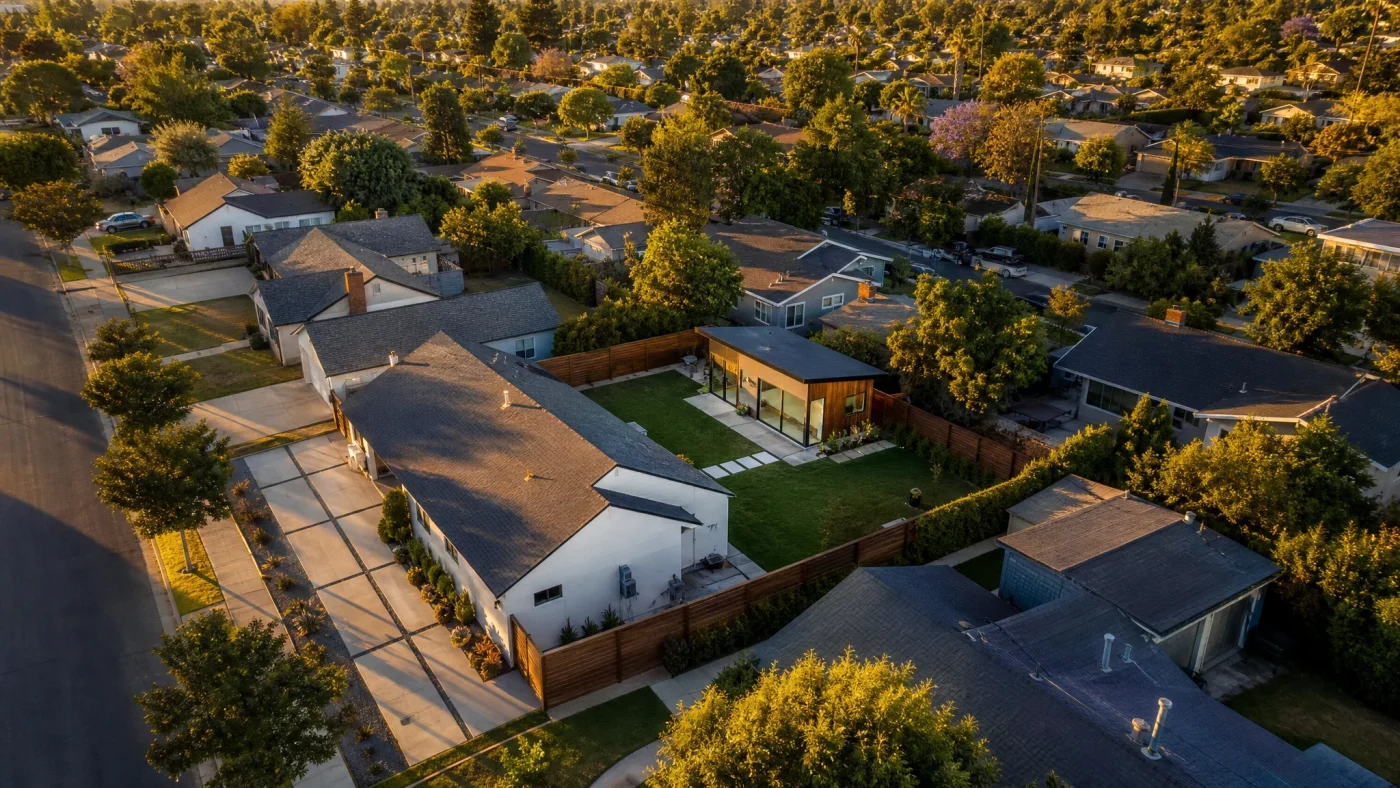
Under the California Energy Code, state adu solar requirements mandate that newly constructed, standalone detached accessory dwelling units must install a dedicated solar photovoltaic (PV) system to pass plan check. However, existing garage conversions, basement conversions, and attached home additions are legally classified as additions or alterations under Section 150.2 of Title 24, which exempts them from mandatory solar panel installations under baseline state law.
Direct Answer: Do You Need Solar Panels for Your California ADU?
If you are building a brand new detached backyard cottage from the ground up, yes: California Title 24 Part 6 mandates on-site solar PV generation sized to the unit floor area. If you are converting an existing permitted garage, carport, or interior living space, no: state law exempts conversions from the solar mandate because they are classified as alterations. You can also meet new-build requirements by expanding the solar array on your main residence or qualifying for specific shade and roof area exemptions.
California ADU Solar Mandates at a Glance
Mandatory
New detached ground-up builds (Title 24 Sec. 150.1)
Exempt
Garage conversions & attached additions (Sec. 150.2)
1.5 to 3.2 kW
Typical required array size (4 to 8 panels)
$5,500-$9,500
Estimated gross hardware & installation cost before tax credit
For many California property owners, discovering that clean energy mandates apply to backyard housing creates immediate confusion. Homeowners wonder whether a 500 square foot detached granny flat requires an expensive commercial-grade solar array, whether their shaded yard can even support panels, or if converting an old detached garage will suddenly trigger a $10,000 clean energy bill.
Understanding how the California Energy Commission (CEC) writes its regulations allows you to design your project efficiently, take advantage of legal exemptions, and avoid costly delays during municipal building department plan review.
Table of Contents
- The Legal Framework: Title 24 and the California Energy Code
- New Detached Builds vs. Conversions vs. Additions
- How Title 24 Solar Sizing Works for an ADU
- Statutory Solar Exceptions Under the Energy Code
- Electric Metering, Interconnection, and NEM 3.0
- Budgeting and Federal Tax Incentives
- Frequently Asked Questions
The Legal Framework: Title 24 and the California Energy Code
California has mandated solar photovoltaic systems on newly constructed single-family homes since the 2019 Energy Code took effect on January 1, 2020. Under Title 24, Part 6 of the California Code of Regulations, this requirement extended directly to newly constructed detached accessory dwelling units.
The mandate stems from California's aggressive climate targets aimed at reducing greenhouse gas emissions and decreasing residential demand on the statewide electrical grid. When you submit construction documents to your local building department, your design set must include an energy compliance report, known as the CF1R-PRF-01-E form. This document proves that your planned building envelope, mechanical equipment, lighting, and solar PV array comply with the annual energy budget calculated for your specific California climate zone.
Without this certified documentation, building officials cannot legally stamp your architectural drawings or issue your building permit. Understanding whether your specific structure qualifies as a newly constructed building or an alteration determines whether solar PV forms must be included in your submittal package. Learn more about the broader submission set in our detailed guide on Title 24 for an ADU.
New Detached Builds vs. Conversions vs. Additions
The most common source of confusion among homeowners is treating all ADUs as identical construction types. Building departments categorize projects strictly by their physical relationship to existing structures.
The application of adu solar requirements hinges entirely on which section of the Energy Code governs your structure:
| Project Type | Code Classification | Solar PV Required? | Primary Code Citation |
|---|---|---|---|
| Ground-Up Detached ADU | Newly Constructed Building | Yes | Section 150.1(c)14 |
| Existing Detached Garage Conversion | Existing Building Alteration | No | Section 150.2(b) |
| Garage Conversion with Minor Bump-Out | Alteration plus Addition | No (unless addition exceeds standalone thresholds) | Section 150.2(a) |
| Attached ADU (Room Addition) | Addition to Existing Home | No | Section 150.2(a) |
| Junior ADU (JADU) | Interior Alteration | No | Section 150.2(b) |
| Second-Story Unit Over Existing Garage | Addition to Existing Structure | No (structural addition) | Section 150.2(a) |
                CALIFORNIA ADU SOLAR APPLICABILITY

        Is your ADU a brand-new, standalone detached building?
                              |
                +-------------+-------------+
                |                           |
               YES                          NO
                |                           |
         Is your roof area            Is it a conversion,
       shaded (>70%) or <80 sq ft?    attached unit, or JADU?
                |                           |
        +-------+-------+                   v
        |               |           SOLAR IS NOT REQUIRED
       YES              NO          BY CALIFORNIA STATE LAW
        |               |           (Section 150.2 applies)
        v               v
    QUALIFIES FOR     SOLAR PV
    LEGAL EXCEPTION   IS MANDATORY
   (No PV required)  (1.5 to 3.2 kW)
1. Ground-Up Detached Construction
If you are excavating fresh soil, pouring a new concrete slab or raised foundation, and framing four new exterior walls completely detached from your primary residence, state law treats that ADU as a newly constructed residential building. Under Section 150.1(c)14, ground-up detached units must provide on-site solar generation unless they meet one of the strict statutory exceptions discussed below. Check typical build parameters in our guide on detached ADU cost.
2. Garage and Accessory Structure Conversions
If you are converting an existing permitted garage, barn, workshop, or pool house into a living unit, you are not erecting a new building envelope. Under Title 24 Section 150.2(b), changes of occupancy and remodeling within existing walls are treated as alterations. The state energy code does not require existing buildings undergoing alteration to install solar panels.
Even if you replace the garage slab, reframe exterior walls for seismic retrofitting, or replace the roof rafters, your project remains an alteration of an existing structure as long as you do not expand the footprint into an entirely new detached building.
3. Attached ADUs and Room Additions
Building an attached ADU by adding square footage directly to the side or rear of your primary residence is classified as a residential addition under Section 150.2(a). The California Energy Code explicitly exempts residential additions from mandatory solar PV panel installation. Your energy consultant will calculate insulation, window glazing, and HVAC performance for the new square footage, but you will not be forced to install rooftop solar modules.
How Title 24 Solar Sizing Works for an ADU
For newly built detached cottages, the state does not expect homeowners to install massive 8 kW to 10 kW residential arrays designed for four-bedroom houses. Instead, solar capacity requirements scale downward to match the modest energy footprint of an accessory unit.
The required PV capacity is determined using Equation 150.1-C from the Energy Code:
$$\text{kW}_{\text{PV}} = \frac{\text{CFA} \times A}{1000} + \frac{B \times \text{NDwell}}{1000}$$
Where:
- CFA is the conditioned floor area of the ADU in square feet.
- A is a climate-zone scaling factor determined by the CEC based on regional solar irradiance and cooling loads.
- B is an energy allowance scaling factor based on single-family or multifamily building type.
- NDwell is the number of new dwelling units (which equals 1 for an ADU).
Typical Solar Panel Sizing by ADU Square Footage
In real-world terms across California climate zones (from coastal Zone 3 in ADU in San Francisco to central valley Zone 12 in Sacramento and inland Zone 10 in Riverside), required systems generally fall into the following brackets:
| ADU Conditioned Floor Area | Typical Required Solar Capacity | Approximate Number of Panels (400W each) | Estimated Annual Output |
|---|---|---|---|
| 350 to 450 sq ft (Studio) | 1.2 kW to 1.6 kW | 3 to 4 panels | 1,800 to 2,400 kWh |
| 500 to 650 sq ft (1-Bedroom) | 1.6 kW to 2.2 kW | 4 to 6 panels | 2,400 to 3,300 kWh |
| 750 to 900 sq ft (2-Bedroom) | 2.2 kW to 2.8 kW | 6 to 7 panels | 3,300 to 4,200 kWh |
| 1,000 to 1,200 sq ft (3-Bedroom) | 2.8 kW to 3.4 kW | 7 to 9 panels | 4,200 to 5,100 kWh |
Can You Put the Panels on the Main House?
Yes. Section 150.1(c)14 allows the required solar system to be located on either the ADU roof, on the roof of the existing primary dwelling, or on a ground-mounted array on the same parcel.
Furthermore, if your primary home already has an oversized solar system that generates surplus kilowatt-hours beyond the main home's historical consumption, your energy consultant can use that existing excess production to satisfy the ADU requirement, provided you can prove the surplus through utility billing records and registered compliance forms.
Statutory Solar Exceptions Under the Energy Code
If your property involves physical limitations that make solar impractical or economically non-viable, California Title 24 provides specific statutory exceptions where a newly built detached ADU can be permitted without any solar panels.
To claim an exemption, your architect or Title 24 consultant must document the condition directly on the CF1R compliance documentation submitted to the city plan checker.
1. The Solar Access Roof Area (SARA) Minimal Area Exception
Under Exception 1 to Section 150.1(c)14, no solar PV system is required if the total Solar Access Roof Area (SARA) is less than 80 contiguous square feet.
SARA is defined as roof area with an annual solar access of 70 percent or greater. Solar access is the ratio of solar insolation including shading to solar insolation without shading. If your ADU has a steeply pitched roof where south-, east-, and west-facing slopes total less than 80 contiguous square feet free of mechanical vents, skylights, and plumbing stacks, the requirement is waived.
2. Excessive Shading from Surrounding Features
Under Exception 2 to Section 150.1(c)14, if external shading from existing mature trees, adjacent multi-story buildings, or hillside topography reduces effective annual solar access below 70 percent across the entire roof surface, you are exempt from the solar mandate.
To document this exemption, your design team must supply a certified solar shade analysis, often generated using tools like a Solmetric SunEye or certified 3D shade simulation software, showing that natural sunlight is insufficient for solar generation.
3. Local Utility and Reach Code Variations
While state law sets the baseline, local jurisdictions have authority to adopt local energy amendments, known as reach codes, approved by the California Energy Commission.
Some environmental reach code cities require all-electric heating and cooling or mandate energy storage readiness, while others offer local community solar options. Always verify whether your municipal building department enforces local amendments that modify state baseline rules. Review regional standards across our local directories for ADU design in California.
Electric Metering, Interconnection, and NEM 3.0
Deciding how to connect your ADU's electrical infrastructure to the power grid has a substantial impact on equipment placement, upfront costs, and ongoing utility bills.
       OPTION A: SHARED SERVICE METER          OPTION B: DEDICATED UTILITY METER

          Utility Distribution Line               Utility Distribution Line
                     |                                       |
                     v                                       +---------------+
             [Main Utility Meter]                            |               |
                     |                                       v               v
            +--------+--------+                         [Meter #1]      [Meter #2]
            |                 |                         (Main House)       (ADU)
            v                 v                              |               |
      [Main House]       [ADU Subpanel]                      v               v
         Panel             (w/ Submeter)                [Main House]     [ADU Panel]
            |                 |                              |               |
            +-- Solar PV Array                               +-- Solar PV ---+
             (Single Interconnection)                       (VNEM / Dual Interconnection)
Shared Meter vs. Separate Meter Tradeoffs
When designing an ADU, homeowners choose between two electrical configurations:
Shared Electrical Meter (Subpanel Configuration):
- The ADU draws power from a subpanel connected to the primary home's 200A main service panel.
- The solar system on the ADU feeds into the single shared utility meter.
- Advantage: Low upfront interconnection cost ($0 to $800 administrative utility fee) and no separate monthly base service fees from the utility.
- Drawback: The property owner receives one combined electric bill. You must install a private revenue-grade submeter ($300 to $600) to bill tenants accurately.
Separate Dedicated Utility Meter:
- The utility installs a dual-meter adapter or a separate electric service drop directly to the ADU.
- Advantage: The tenant sets up their own utility account and pays their bills directly to the electric company.
- Drawback: Utilities (such as PG&E, Southern California Edison, or San Diego Gas & Electric) routinely charge $2,500 to $8,000 to trench, install, and interconnect a new service meter. Furthermore, under California's current billing rules, linking solar on an ADU across separate meters requires complex Virtual Net Metering (VNEM) tariffs.
Understanding California NEM 3.0 (The Solar Billing Plan)
In April 2023, the California Public Utilities Commission replaced the legacy NEM 2.0 net metering system with the Solar Billing Plan (widely known as NEM 3.0). Under NEM 3.0, the credit value utilities pay homeowners for exporting daytime solar power back to the grid dropped by roughly 75 to 80 percent.
Because export credits are small, the economic return of solar now depends heavily on self-consumption: using your solar energy on-site as it is being produced. Because an ADU runs air conditioning, water heating, and appliances during the day and evening, pairing an ADU solar system with a compact residential battery storage system (such as a 5 kWh to 10 kWh battery) allows you to store daytime production for tenant evening use, significantly lowering net electricity expenses.
Budgeting and Federal Tax Incentives
Planning for solar panels requires factoring equipment, permitting fees, and tax credits into your initial feasibility numbers.
Real-World System Pricing
A standard Title 24 compliant solar system for a newly constructed 600 to 800 square foot detached ADU (approximately 2.0 kW to 2.6 kW) generally costs between $5,500 and $9,500 installed by a licensed C-10 electrical contractor or solar installer.
Illustrative Budget Breakdown (2.4 kW System, 6 Panels):
- Solar photovoltaic panels (6 x 400W monocrystalline):    $2,200 - $3,000
- Microinverters or string inverter with optimizers:       $1,200 - $1,800
- Rooftop racking, flashing, and conduit:                  $800 - $1,200
- Electrical labor, connection, and testing:               $1,500 - $2,300
- City solar permit fee and utility interconnection:       $400 - $800
--------------------------------------------------------------------------
Total Gross Cost:                                          $6,100 - $9,100
Less 30% Federal Clean Energy Tax Credit (Section 25D):   -$1,830 - -$2,730
--------------------------------------------------------------------------
Net Homeowner Investment:                                  $4,270 - $6,370
The 30 Percent Federal Clean Energy Credit
Under Section 25D of the Internal Revenue Code, homeowners who purchase and install solar photovoltaic systems on residential property are eligible for a 30 percent federal tax credit applied against their federal income tax liability.
If you build an ADU on your primary residence, the solar installation qualifies for this credit through at least 2032. If the ADU is used solely as an income-producing rental property, commercial energy tax credits under Section 48 may apply instead. Always consult a certified tax professional to verify how federal investment tax credits apply to your specific filing status.
Main Service Panel Upgrades (The 200A Question)
Older California residences commonly feature 100-amp or 125-amp main electrical service panels. Building an all-electric ADU equipped with a heat pump mini-split, heat pump water heater, electric dryer, and induction cooktop often requires upgrading the main service panel to a modern 200-amp panel.
Adding solar PV backfeed into your main panel requires compliance with the 120 percent rule in the National Electrical Code (NEC Article 705.12). Your electrical designer will evaluate whether your existing busbar can accept solar breaker backfeed without triggering an unscheduled panel changeout.
Does Your Property Qualify for an ADU?
We check your lot size, setbacks, utility access, and California Title 24 solar requirements for free before you spend money on custom plans. You pay nothing if your property does not qualify.
Check my lot freeFrequently Asked Questions
Do garage conversion ADUs in California require solar panels?
No. Under Section 150.2(b) of the California Energy Code (Title 24, Part 6), converting an existing permitted garage into an ADU is categorized as an alteration of an existing structure. Alterations and additions do not trigger the mandatory solar photovoltaic requirement under state law. You only need solar if your local city has enacted an approved reach code requiring solar on all residential remodels, which is uncommon.
Can I connect the ADU solar panels to my primary home electrical panel?
Yes. Title 24 regulations allow the required solar photovoltaic capacity to be mounted on either the ADU roof or the existing primary dwelling roof, and interconnected into the shared service panel. As long as the newly installed system meets the kilowatt capacity required by your ADU's Title 24 compliance calculation, the physical location on the parcel is flexible.
What happens if my backyard has too many shade trees for solar?
If existing mature trees or adjacent multi-story buildings shade your roof such that annual solar access is less than 70 percent, your architect or Title 24 consultant can claim statutory Exception 2 to Section 150.1(c)14. Submitting a certified solar shade analysis showing this condition exempts you from installing solar panels, allowing you to pass plan check without penalty.
Can I lease solar panels for my ADU to satisfy Title 24?
Yes. The California Energy Commission permits leased solar systems or power purchase agreements (PPAs) to fulfill the Title 24 solar mandate, provided the lease agreement has an initial term of at least 10 years and meets standard CEC consumer protection rules. However, outright cash purchase or direct solar equipment financing generally delivers a higher financial return and avoids property title complications when selling your home.
How many solar panels are typically needed for an ADU?
Most detached California ADUs ranging from 500 to 800 square feet require a system sized between 1.6 kW and 2.6 kW. Using modern 400-watt monocrystalline solar panels, this equals approximately 4 to 7 panels. Because the system is small, it occupies roughly 80 to 140 square feet of roof space.
Will solar panels power the ADU during a grid power outage?
Standard grid-tied solar systems automatically shut down during a utility power outage for line-worker safety. If you want your ADU to have backup power during blackout events or severe weather, you must install an energy storage system (battery backup) with an automatic transfer switch.
Related Resources
Related Services