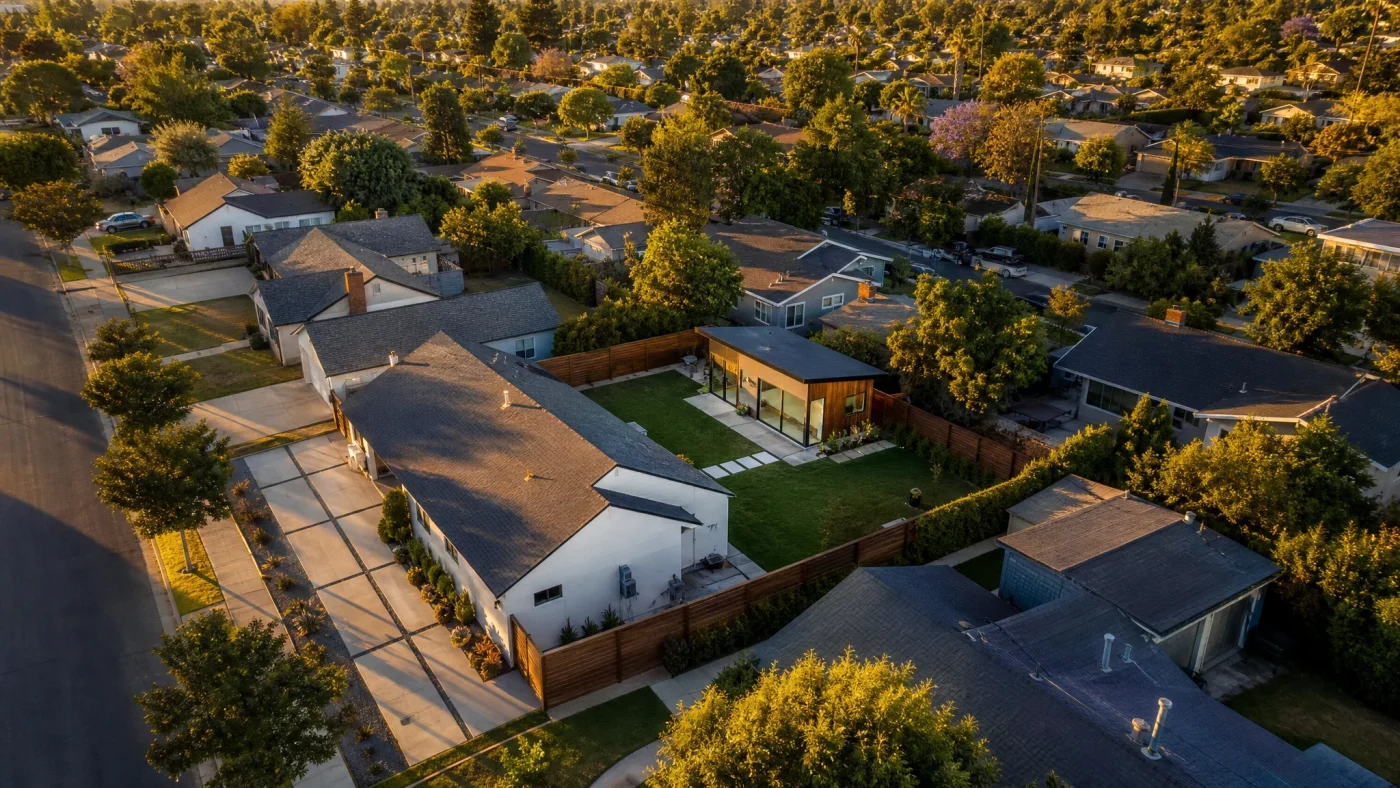
Detached ADU cost runs $300 to $450 per square foot, or roughly $180,000 to $350,000 for a typical unit, about 35% to 50% more than an attached ADU built on the same lot. The gap is not padding, and it is not a builder testing what you will tolerate. It comes from three things an attached unit gets for free: a shared foundation, a shared roofline, and utility lines that already run to the house. A detached unit has to bring its own of everything, plumbing, wiring, and a slab, starting from bare dirt.
Think of it as the difference between crashing in your buddy's spare room and building your own place on an empty lot. One option means you show up with a sleeping bag. The other means you are now personally responsible for a foundation, a water line, and an electrical panel that did not exist yesterday. Both get you a place to live. Only one of them requires a permit and a concrete truck.
Detached ADU Cost At a Glance
$300-$450/sq ft
Typical detached ADU construction cost
$180K-$350K
Est. total cost, typical detached unit
$25K-$55K+
Est. utility hookup cost, detached unit
10 Business Days
To get permit-ready plans started
Detached vs. Attached: What You Are Actually Paying For
A detached ADU is a fully separate structure, built somewhere else on the lot with no shared wall to the main house. An attached ADU shares at least one wall, and often the roofline, with the existing home. That distinction sounds like a design preference. It is really a cost driver, because everything a detached unit needs, it needs on its own: its own foundation, its own roof structure, and its own electrical, water, and sewer connections run out to wherever the unit sits.
An attached unit borrows. The foundation might extend from the existing footing. The roof can tie into the existing structure instead of framing a new one from scratch. Plumbing and electrical often run a shorter distance because they are tapping into a wall the utilities already reach. None of that makes an attached ADU cheap. It just means fewer line items start at zero.
So why do homeowners pay the detached premium at all? Mostly for the thing money does not directly buy: real separation. A detached unit gets its own entrance, its own walls on every side, and none of the noise transfer or shared-wall awkwardness that comes with an attached suite. For a rental, that separation is often the difference between a tenant who feels like a guest and one who feels like a roommate. For a parent or adult child, it is the difference between a private home and a room down the hall. Whether that separation is worth 35% to 50% more depends on what you plan to do with the unit, which is exactly the question our attached vs. detached comparison guide is built to help you answer.
Detached ADU Cost by Square Footage
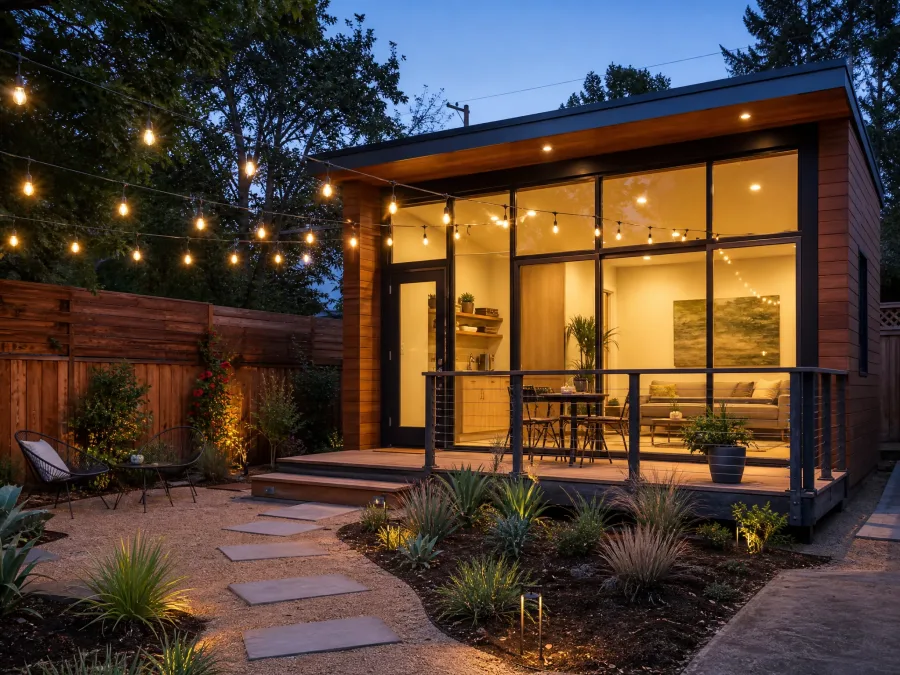
Detached ADU construction cost typically lands between $300 and $450 per square foot, depending on your market, finish level, and how far the unit sits from existing utility lines. Here is what that looks like across the sizes homeowners actually build.
| Size | Estimated Cost (Detached) |
|---|---|
| 400 sq ft (studio) | $120,000-$180,000 |
| 600 sq ft (1BR) | $180,000-$270,000 |
| 800 sq ft (1-2BR) | $240,000-$360,000 |
| 1,000+ sq ft (2BR) | $300,000-$450,000+ |
These are construction estimates, not a quote for your address. A lot with easy truck access and level ground lands toward the low end. A sloped backyard, a unit set far from the street, or finishes above the standard grade push it toward the high end or past it. Our full ADU construction cost guide breaks down the same ranges by ADU type, including JADUs and garage conversions, which is worth reading if you have not settled on detached yet.
Attached ADU Cost, for Comparison
Attached ADU cost typically runs $250 to $375 per square foot, or about $120,000 to $250,000 total for a standard unit, roughly 35% to 50% less than a detached unit of the same size. The savings come from the same three items covered above, run in reverse: a shared or extended foundation, a roof that ties into the existing structure, and shorter utility runs because the connection point is already close by.
That does not make attached the automatically right answer. An attached unit changes how your existing home functions, since it is physically bolted onto it, and it can complicate privacy, separate-entrance requirements, and resale as a distinct legal unit depending on your city's rules. Detached buys separation at a real price. If you are still weighing the two, our comparison guide on attached vs. detached ADU configurations goes deeper on layout, privacy, and long-term flexibility than the cost angle alone can cover.
The Real Reason Detached Costs More
Two line items account for most of the gap between detached and attached pricing: the foundation and the utility hookups. Neither one is optional, and neither one shrinks much just because your unit is on the smaller side.
Foundation. A detached ADU needs its own slab or crawlspace foundation poured from scratch, engineered to local soil and seismic requirements. An attached unit, especially one built over an existing garage or added onto an existing footing, can sometimes avoid this cost entirely or share it with the main structure. There is no clean, universal dollar figure for "foundation cost" on its own, because soil conditions, lot slope, and local code requirements move it too much city to city. Treat it as a real line item your contractor will price against your specific lot, not a number you can budget from a national average.
Utility hookups. This is where detached and attached diverge hardest, and it is the line item first-time homeowners underbudget most often. A garage conversion, which already sits close to existing lines, typically runs $10,000 to $20,000 to connect water, sewer, and electrical. A detached backyard unit set farther from the house runs $25,000 to $55,000 or more for the same three connections, depending almost entirely on distance and what is already buried in your yard. Electrical alone typically costs $2,000 to $5,000 for a new meter and connection, more if your panel needs an upgrade. Trenching to reach a distant unit adds roughly $50 to $100 per linear foot on top of that.
One piece of good news: for ADUs under 750 square feet, sewer connection fees and most impact fees are waived under California state law, which removes one of the larger variable costs for smaller units in that state. If your lot needs a lateral upgrade regardless of size, though, budget $15,000 to $30,000 for that separately. Rules vary in Texas, Florida, Arizona, Colorado, and Washington, so treat the waiver as a California-specific detail, not a universal one. And if your contractor quotes trenching at $50 to $100 a linear foot, resist the urge to just count paces across your yard and multiply. Buried irrigation lines, tree roots, and the occasional mystery pipe from a 1970s renovation have a way of turning a tidy estimate into a change order.
Soil matters too, and it gets skipped over more than it should. A detached foundation has to be engineered to your actual soil conditions, not a generic slab spec, which is why two lots on the same street can price out differently once a geotechnical report comes back. Expansive clay, a high water table, or a documented slope all add engineering cost before the first yard of concrete gets poured. None of this shows up on a per-square-foot rule of thumb, which is exactly why that rule of thumb is a starting point for your budget conversation, not the end of it.
Get a Real Number for Your Specific Lot
We check your address against your city's zoning rules and utility distances and tell you what your lot actually supports, free. You pay nothing if your property does not qualify.
Check My Property: It's Free →What Else Moves Your Specific Number
Foundation and utilities explain most of the detached-versus-attached gap, but four other factors decide where you land inside the $300-$450 per square foot range once you have picked a type.
- Lot access and slope. A backyard a concrete truck can reach directly costs less to build on than one requiring hand-carried materials through a side gate.
- Distance from the street. Every extra foot of trenching for water, sewer, or electrical adds $50 to $100 per linear foot, and detached units set deep in a backyard rack this up fast.
- Finish level. Stock cabinets and a standard tile package land toward the lower end of the range. Custom millwork and higher-end fixtures push it well past $450 per square foot.
- Local labor rates. Coastal California and parts of Washington run higher than Texas or Florida for the same scope of work, sometimes by a wide enough margin to change which end of the national range applies to you.
None of these show up on a generic cost calculator, which is exactly why two homeowners building the same 600 square foot detached unit in different cities, or even different backyards in the same city, can land $60,000 apart on the final number.
Detached ADU Cost vs. a Home Addition
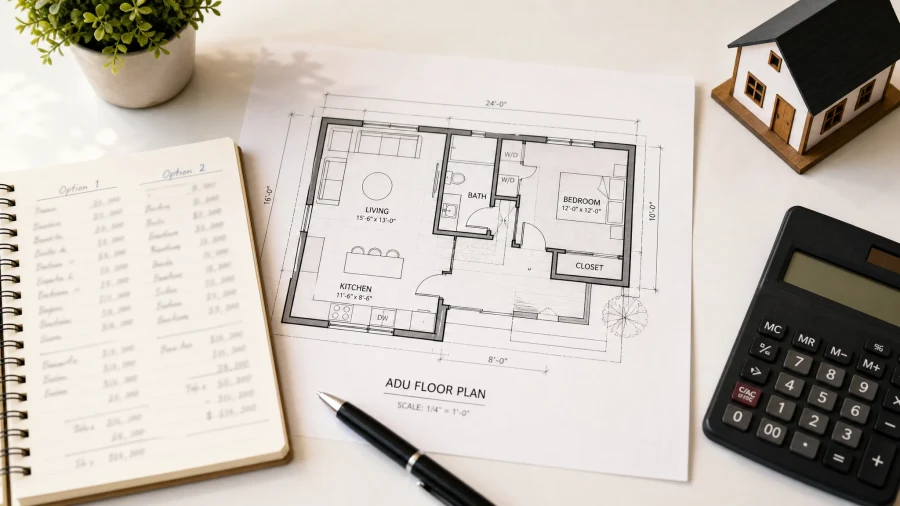
Homeowners weighing a detached ADU against a traditional home addition are often comparing two different price tags without realizing it. Our home addition cost guide puts a standard ground-floor addition at roughly $80 to $200 per square foot, noticeably cheaper on paper than a detached unit's $300 to $450. The comparison only holds up, though, if the two projects deliver the same thing, and they usually do not. An addition typically expands the existing house. A detached ADU creates a second, independently rentable structure with its own address-eligible entrance in most cities. You are not paying more for the same square footage. You are paying for a structure that can generate its own income, which an addition to your primary living room generally cannot.
How to Get Started
- Run a free feasibility check. We confirm your lot qualifies and flag the site-specific factors, slope, utility distance, lot access, that will move your number before you spend anything. If it does not qualify, you pay nothing.
- Get permit-ready plans. Starting at $997 for self-serve packages, or $6,000 for a fully custom-drawn set with a project coordinator managing your city's permit submission, delivered in 10 business days and backed by a 14-day money-back guarantee.
- Get matched with a vetted builder once your plans are permit-ready, who can price the foundation and utility work against your actual lot instead of a national average. For a market-specific look, see ADU design in Los Angeles.
Once your unit is built and generating income, our city-by-city rental income breakdown and guide to ADU financing options are the natural next reads, one shows what the finished unit can earn, the other shows how to fund the number you land on above. And if $180,000 still sounds like a lot to spend on a building you cannot even put a couch in yet, the full ADU construction cost guide lays out the cheaper paths, JADUs and garage conversions among them, in case detached turns out to be more separation than your budget wants to pay for.
Frequently Asked Questions
How much does a detached ADU cost?
A detached ADU typically costs $300 to $450 per square foot, or roughly $180,000 to $350,000 total for a standard unit. The exact number depends on lot access, distance from existing utility lines, and finish level.
What is the average cost of an attached ADU?
Attached ADU cost typically runs $250 to $375 per square foot, or about $120,000 to $250,000 total, roughly 35% to 50% less than a detached unit because it can share a foundation, roofline, and shorter utility runs with the existing house.
Why does a detached ADU cost more than an attached one?
A detached ADU needs its own foundation and its own water, sewer, and electrical connections built from scratch, while an attached unit can often share or extend the existing home's foundation and utility lines. Utility hookups alone typically run $10,000 to $20,000 for a garage conversion versus $25,000 to $55,000 or more for a detached backyard unit.
Is a detached ADU cheaper to build per square foot on a small footprint?
Not proportionally. Foundation and utility connection costs are largely fixed regardless of unit size, so a smaller detached ADU still carries close to the full utility and foundation premium, which is why small detached units often land near the higher end of the per-square-foot range rather than the lower end.
Do I need a permit for a detached ADU?
Yes. A detached ADU needs a building permit to be legally habitable and eligible for rental income or a home value increase. Most of Build With A Plan's service states, including California, Colorado, Washington, and Oregon, have statewide laws requiring cities to allow ADUs by right, though Texas and Florida still rely on city-by-city ordinances.
Are utility hookups included in detached ADU construction cost estimates?
Sometimes, but not always, which is a common source of budget surprises. Confirm with your builder whether their quote includes water, sewer, and electrical connection costs or treats them as a separate line item, since that gap alone can run $25,000 to $55,000 for a detached unit.
Related Services