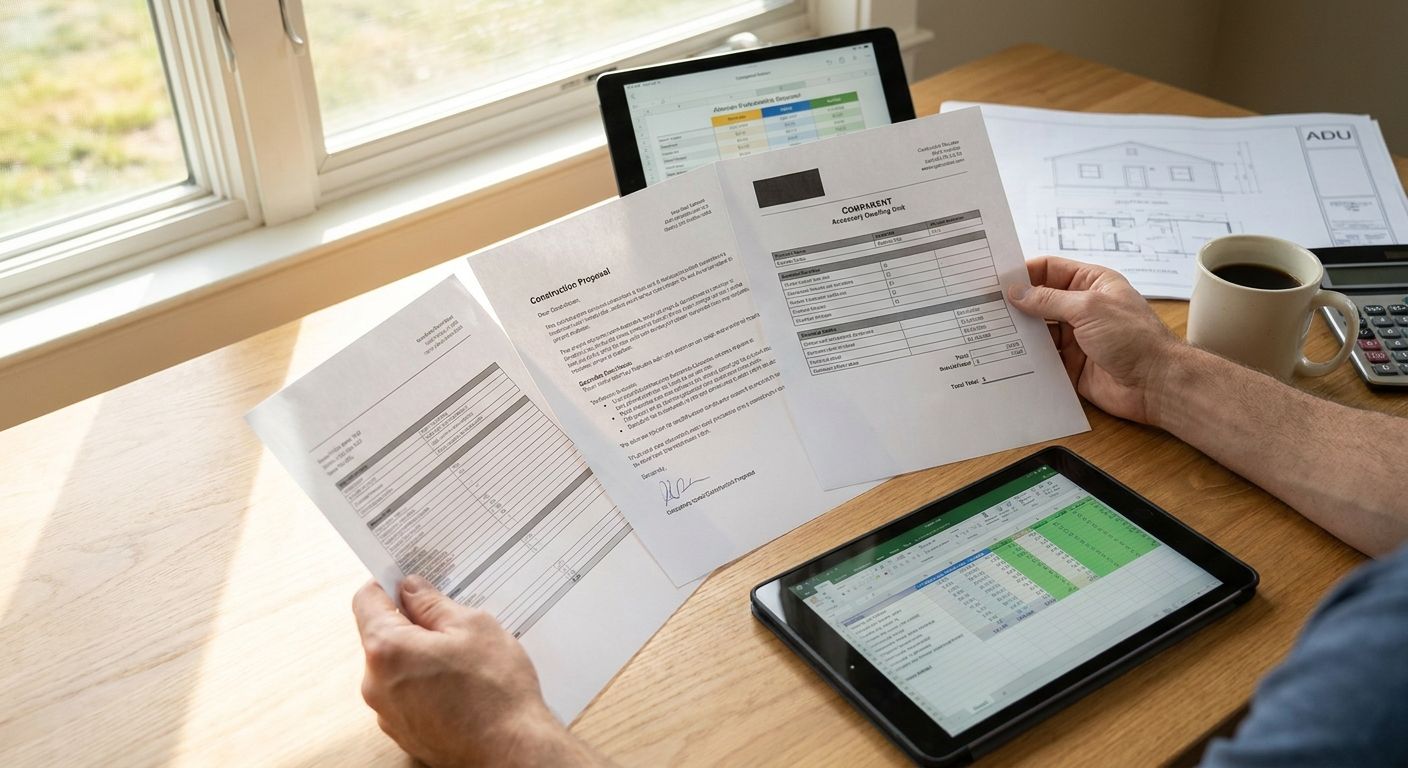
Three ADU builder bids can come back $60,000 apart for the exact same backyard, and the low number is rarely the safe one. Knowing how to compare ADU builder bids means reading scope, allowances, and payment terms line by line — not just the total at the bottom.
- Comparing ADU builder bids means matching scope, allowances, and payment terms line by line, not the bottom-line number alone.
- California caps ADU contractor deposits at 10% of contract price or $1,000, whichever is less — bids asking more are a Skip.
- A bid without itemized allowances is a Wait: verify unit pricing before you sign anything in 2026.
- Use a fixed, permit-ready design as your scope baseline so every builder bids the identical job.
- A bid missing a written change-order process is a Skip regardless of price.
Why This Matters
An ADU builder bid is not a menu price — it's a legal document that determines who eats the cost when the job runs long, when the concrete truck shows up late, or when the inspector fails the first pass. Two bids for the same square footage can hide a $30,000 gap simply because one includes a real electrical panel upgrade and the other assumes the existing panel is fine.
Homeowners who compare bids on price alone in 2026 end up signing change orders they never budgeted for. The fix isn't finding a cheaper builder — it's forcing every bid to respond to the same fixed scope so the numbers are actually comparable.
How to Score Every Bid
A bid review works the same way a permit reviewer works: same checklist, same order, every time. Score each bid against six factors, not the total price, and you catch the gaps before you're locked into a contract.
The baseline that makes this possible is a permit-ready design set finished before bids go out. Build With A Plan delivers that design package in a flat-fee, 10-day turnaround specifically so every builder is quoting the identical drawings — same square footage, same fixtures, same electrical load. Bid comparisons fall apart the moment builders are pricing against different assumptions.
1. Scope of Work Detail
The fine print that decides everything else. A one-page bid that says "build 800 sq ft ADU per plans" tells you nothing about finish level, appliance allowances, or site prep. A real bid itemizes foundation type, framing package, roofing material, and mechanical systems line by line.
If a builder can't produce a scope longer than half a page, they haven't priced the job — they've guessed at it. Verdict: Skip any bid without a line-item scope of work.
2. Payment Schedule Structure
The number most homeowners never check. California caps residential contractor deposits at 10% of the contract price or $1,000, whichever is less, under Business and Professions Code Section 7159. A bid asking for 25% or 30% up front, in California, is not just aggressive — it's noncompliant.
A sound payment schedule ties draws to completed milestones — foundation poured, framing inspected, drywall hung — not to calendar dates. Verdict: Skip any bid that front-loads payment past what state law allows in your market.
3. Allowances and Unit Pricing
The number that changes after you sign. Allowances are placeholder budgets for items not yet selected — flooring, countertops, plumbing fixtures. A bid that lists a $3,000 kitchen allowance without square footage or a per-unit rate leaves you exposed to a change order the moment you pick real materials.
Ask every builder for the per-unit rate behind each allowance, not just the dollar total. If vetting an ADU builder before signing a contract taught you anything, it's that vague allowances are where final invoices balloon. Verdict: Hold — get the itemized breakdown before comparing this line across bids.
4. Permit and Inspection Responsibility
Who eats the delay cost. Some builder contracts assume permits are already pulled and approved; others quietly build permit runtime into your project timeline without saying so. If your design and permit package already carries a 98% first-submission approval track record, the builder shouldn't be pricing in permit risk you've already removed.
Confirm in writing whether the builder handles inspections and re-submittals or whether that responsibility sits with you. Verdict: Buy bids that state permit responsibility explicitly; Skip bids that leave it ambiguous.
5. Timeline With Penalty Clauses
The promise with no teeth. A builder quoting "4-5 months" without a contractual completion date and penalty clause is giving you a guess, not a commitment. Timelines without consequences slip — every month of slippage on a rental ADU is a month of lost income.
Look for a stated substantial-completion date and a per-day penalty for missed milestones outside of permit delays or weather. Verdict: Hold any bid with a timeline but no enforcement mechanism.
6. Warranty and Change-Order Terms
The fine print that shows up after move-in. A bid silent on warranty length or change-order approval process is a bid that assumes you won't ask. Reputable builders state a workmanship warranty period and require written, signed change orders before extra charges hit your invoice.
If a bid has no change-order language at all, assume verbal add-ons will show up on the final bill with no paper trail. Verdict: Skip bids with no written change-order process, no matter how competitive the base price looks.
Get bids that price the same scope
A permit-ready design set means every builder quotes an identical job.
Bid Comparison at a Glance
| Bid Factor | Good Bid Looks Like | Red Flag | Verdict |
|---|---|---|---|
| Scope of work | Line-item detail: foundation, framing, roofing, mechanicals | One-paragraph summary | Skip if vague |
| Payment schedule | Milestone-based draws, deposit within state cap | 25-30% deposit up front | Skip if over cap |
| Allowances | Per-unit pricing behind every allowance | Flat dollar figure, no units | Hold until itemized |
| Permit responsibility | Builder states who handles inspections | Silent on permit ownership | Skip if ambiguous |
| Timeline | Completion date with penalty clause | "4-5 months," no enforcement | Hold without penalty terms |
| Warranty / change orders | Written warranty period, signed change-order process | No warranty language | Skip if missing |
Where to Source the Bids
Getting the comparison table right doesn't matter if the bids themselves are thin. Three sourcing rules keep the pool honest:
- Collect at least three bids against the identical permit-ready design set — fewer than three and you can't tell if a number is competitive or just average.
- Never let a builder redesign the scope mid-bid. If a builder wants to swap materials or resize a room to hit a lower number, that's a different project, not a lower price.
- Match financing timeline to bid timeline. If you're funding the build with a HELOC for ADU construction or need to get pre-qualified for ADU financing before you design, lock financing before bids expire — most bids hold pricing for 30-60 days.
FAQ
What's the best way to compare ADU builder bids in 2026?
Compare bids against an identical permit-ready design set and score each one on scope detail, payment schedule, allowances, permit responsibility, timeline, and warranty terms — not the total price alone. Bids priced against different scopes can't be compared honestly no matter how close the numbers look.
How many ADU builder bids should you collect?
Collect at least three bids against the same fixed design before choosing a builder. Two bids only tell you one is higher or lower; three start showing you where the market actually sits.
Is the cheapest ADU builder bid usually the best deal?
No — the cheapest bid is often missing scope items that show up later as change orders. A bid with a shorter line-item list almost always ends up costing more once the gaps surface mid-build.
What's a normal deposit for an ADU builder in California?
California law caps residential contractor deposits at 10% of the contract price or $1,000, whichever is less, under Business and Professions Code Section 7159. A bid requesting more than that in California is noncompliant.
Should ADU allowances be itemized in a builder bid?
Yes — every allowance should carry a per-unit rate, not just a flat dollar figure. Without unit pricing, you can't tell if the allowance covers your actual material choices until after you've signed.
Who handles permit delays in an ADU builder contract?
The bid should state explicitly whether the builder or the homeowner is responsible for permit resubmittals and inspection scheduling. Leaving this ambiguous is how delay costs quietly land on the homeowner.
How much does ADU design and permitting cost?
Build With A Plan's permit-ready design and permit management runs a flat $6,000 fee with a 10-day design turnaround, giving every bidder the same finished plan set to price against.
What red flags should you avoid in an ADU builder bid?
Watch for vague scope language, deposits above the state legal cap, allowances with no unit pricing, and no written change-order process. Any one of these is enough to flag a bid as incomplete, even at a competitive price.
One Last Thing
Most homeowners request builder bids before the design is finished, then wonder why the numbers don't line up. Sequence it the other way: finish the permit-ready design first, so every builder in 2026 is bidding the exact same drawings, fixtures, and load calculations. That single change does more to make bids comparable than any checklist ever will.