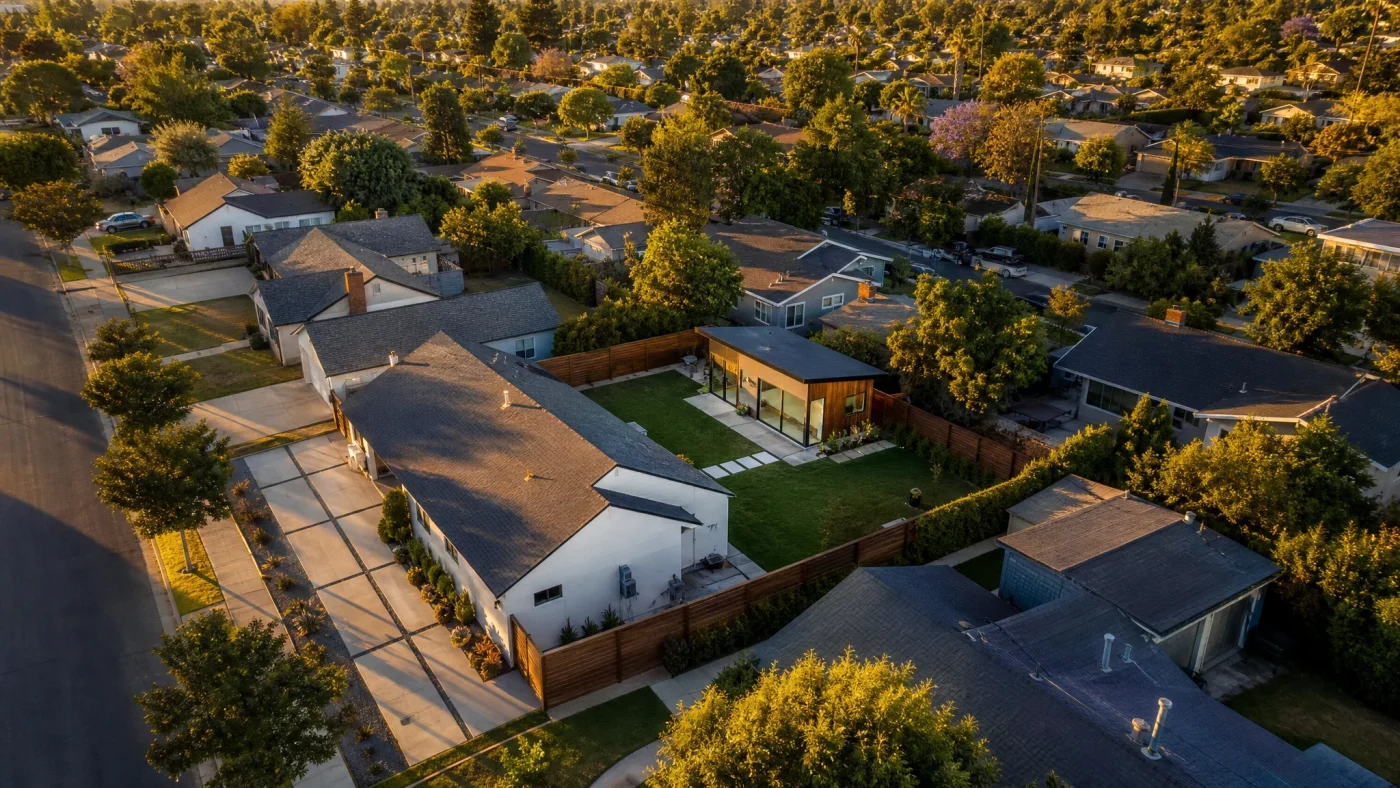
Your standard homeowners policy almost certainly does not cover your adu insurance needs the way you assume it does. A detached unit typically falls under "Other Structures" coverage, capped at an estimated 10% of your dwelling coverage limit, which on a lot of policies would not come close to rebuilding a $150,000 backyard home. Rent the unit out to a tenant, and most standard policies stop covering it in any meaningful way at all.
None of this means an ADU is uninsurable. It means the paperwork step homeowners skip most often, calling the insurance company, is the one that actually determines whether a fire, a burst pipe, or a tenant's slip-and-fall lawsuit gets paid or denied. Here is exactly what changes once you add an ADU, what it costs to close the gap, and why the permit you already need for city approval is doing double duty with your insurer too.
ADU Insurance At a Glance
10%
Typical Other Structures limit, as a share of dwelling coverage
$200-$800/yr
Est. cost to add ADU coverage to a homeowners policy
$500K-$1M
Preferred liability coverage for a rented ADU
10 Business Days
To get permit-ready plans started
In This Guide
- Does Homeowners Insurance Cover an ADU?
- Attached vs. Detached: Different Coverage Paths
- Renting the Unit Out Changes Everything
- What ADU Insurance Actually Costs
- Liability: The Risk Homeowners Underestimate
- The Unpermitted ADU Insurance Trap
- How to Get Started
- Frequently Asked Questions
Does Homeowners Insurance Cover an ADU?
Sometimes, and only partially. A standard homeowners policy is written around one home on one lot, and an ADU is, functionally, a second home on that same lot. Insurers have caught up to accessory dwelling units faster than city zoning codes did in some states, but "caught up" mostly means they built a coverage category for it, not that the category automatically protects you the way you would hope.
Think of your policy like a gym membership that came with one free guest pass. The pass covers a guest who shows up occasionally and uses the same equipment you do. It was never built for a second person who lives there full-time, brings their own furniture, and pays you rent. That is roughly the gap between what a standard homeowners policy assumes and what an occupied, income-producing ADU actually is.
Attached vs. Detached: Different Coverage Paths
An attached ADU, one that shares a wall or roofline with the main house, is typically the easier of the two to insure. Once you notify your carrier, an attached unit usually gets folded into your existing dwelling coverage, the same line item that already covers your kitchen and bedrooms. The main thing that changes is the number: adding livable square footage raises your home's replacement cost, so your dwelling coverage limit needs to go up to match, or you are underinsured on the whole house, not just the new unit.
A detached ADU takes a different path. Most policies place detached structures, garages, sheds, and backyard units alike, under "Other Structures" coverage (often labeled Coverage B), typically capped at an estimated 10% of your dwelling coverage limit. On a $400,000 dwelling policy, that works out to roughly $40,000 in Other Structures coverage. A modest ADU can cost three to four times that to rebuild, which means the standard limit alone will not come close to covering a total loss. This is exactly why our attached vs detached ADU guide is worth reading before you finalize a design, since the configuration you choose changes your insurance math along with your construction cost.
| ADU Type | Typical Coverage Path | What Usually Needs to Change |
|---|---|---|
| Attached, owner-occupied by family | Folded into dwelling coverage | Raise dwelling limit to reflect added square footage |
| Detached, owner-occupied by family | Other Structures coverage (Coverage B) | Raise the Other Structures limit or add an endorsement |
| Either type, rented to a tenant | Typically needs landlord or rental-dwelling coverage | Add a landlord policy or rental endorsement |
Renting the Unit Out Changes Everything
If the plan for your ADU is rental income, and for most homeowners building one, it is, the insurance conversation changes the moment a tenant who is not family moves in, typically for stays of six months or longer. Standard homeowners policies are built around owner-occupied risk. A tenant relationship introduces a different set of exposures: lost rental income if the unit becomes uninhabitable after a covered loss, damage caused by someone who is not you, and liability if a tenant or their guest gets hurt on the property.
That is the gap a landlord policy, sometimes called a rental-dwelling or DP-3 policy, is built to close. It typically layers on top of or replaces your existing coverage for the rented structure specifically, and it is the piece most DIY ADU insurance setups get wrong, either by not adding it at all or by assuming the standard homeowners policy quietly extended itself to cover a paying tenant. It did not.
Once you have permit-ready plans and a completion date in view, this is the same conversation worth having alongside financing. Our ADU financing guide covers how lenders and insurers interact on a construction loan, since some lenders require proof of adequate coverage before funding releases.
Find Out What Your Lot Actually Supports
We check your address against your city's zoning rules and tell you the size and configuration your property qualifies for, free. You pay nothing if it does not qualify.
Check My Property: It's Free →What ADU Insurance Actually Costs
Adding an ADU to your insurance is not free, but it is a small line item compared to what it protects. Extending an existing homeowners policy to properly cover an owner-occupied ADU typically adds an estimated $200 to $800 a year to your premium, depending on the carrier, the unit's size, and how much your Other Structures or dwelling limit needs to increase. A standalone landlord policy for a rented ADU runs higher, typically an estimated $500 to $1,500 a year, since it is underwriting a different, higher-risk category of use.
Compare either number to the cost of an uncovered claim, and the math is not close. If a detached ADU with a $40,000 Other Structures limit burns down and actually costs $150,000 to rebuild, the roughly $500 you might have spent on an endorsement looks less like an expense and more like the cheapest insurance decision you made all year.
| Coverage Type | Estimated Annual Cost |
|---|---|
| Homeowners policy extension (owner-occupied ADU) | $200 to $800 |
| Standalone landlord / rental-dwelling policy | $500 to $1,500 |
| Umbrella liability add-on ($1M coverage) | $150 to $400 |
These are planning ranges, not a binding quote. Your actual premium depends on your state, your carrier, your unit's square footage, and whether you are adding coverage to an existing policy or shopping a new one. Treat the table as a budgeting input alongside the numbers in our ADU construction cost guide, not as a substitute for calling your agent once your plans are final.
Liability: The Risk Homeowners Underestimate
Property damage is the risk homeowners think about first. Liability is the one that actually keeps insurance agents up at night, because it has no natural ceiling. A tenant who slips on an icy walkway, a guest injured on a poorly lit staircase, a dog bite in the backyard, any of these can turn into a claim that outpaces a standard policy's default liability limit fast.
For a rented ADU specifically, an estimated $300,000 is typically treated as the floor for liability coverage, with $500,000 to $1,000,000 preferred once real tenants are in the picture. An umbrella policy is the common way to get there without overhauling your entire homeowners policy: it typically adds an estimated $150 to $400 a year in exchange for an additional $1,000,000 in liability protection layered on top of whatever your base policy already carries.
One disclosure detail matters here too: a homeowners umbrella policy typically carries rental exclusions by default, so adding an umbrella policy does not automatically extend to a rented ADU unless your insurer knows about the rental use and prices the policy accordingly. Tell them before you need to file a claim, not after.
The Unpermitted ADU Insurance Trap
Here is the part of ADU insurance that turns a routine policy update into a genuinely expensive mistake. Standard policies typically exclude unpermitted structures from coverage outright, and failing to tell your insurer about an unpermitted unit can be treated as material misrepresentation, a legal phrase that translates roughly to "you did not tell us something that mattered," which can put your entire policy at risk of being voided, not just the ADU itself.
That is a harsher outcome than most homeowners expect. The unpermitted structure does not just fail to get covered on its own. It can become the reason an unrelated claim on the main house gets denied too, if the insurer determines you withheld a material fact about the property. A tenant injury claim in an unpermitted unit carries the same exposure, since the insurer can point to the missing permit as grounds to deny coverage entirely, leaving you personally on the hook for medical costs, legal fees, and whatever a court decides you owe.
This is the same reason the permit step matters more than almost anything else in an ADU project, and it lines up exactly with what we found writing about how appraisers value ADUs: an unpermitted unit is treated as though it does not exist, whether you are talking to an appraiser or an insurance adjuster. A permitted unit gets insured like the real asset it is. An unpermitted one is a liability wearing an asset's clothes.
How to Get Started
Insurance is a downstream decision. It only works cleanly once the permit, the design, and the use case (family member vs. tenant) are locked in, which is why it belongs on your checklist right after permitting, not before.
- Run a free feasibility check. We confirm your lot qualifies before you spend anything. If it does not qualify, you pay nothing.
- Get permit-ready plans. Starting at $997 for self-serve packages, or $6,000 for a fully custom-drawn set with a project coordinator managing your city's permit submission, delivered in 10 business days and backed by a 14-day money-back guarantee. A permitted, documented unit is the version your insurer will actually cover.
- Call your insurance agent once plans are final to update your dwelling or Other Structures coverage, and add a landlord policy if renting is the plan. Do this before construction starts, not after your first tenant moves in.
Once your unit is built, permitted, and insured, our city-by-city rental income breakdown shows what it can realistically earn, and our ADU appraisal guide covers how that same permit paperwork protects your home's equity on top of your insurance coverage. For a market-specific look at the design and permitting side, explore ADU design in Los Angeles.
Frequently Asked Questions
Does homeowners insurance cover an ADU?
Partially. An attached ADU can typically be folded into your existing dwelling coverage once you notify your insurer. A detached ADU typically falls under Other Structures coverage, capped at an estimated 10% of your dwelling coverage limit, which is often not enough to fully rebuild the unit.
Do I need separate insurance to rent out my ADU?
In most cases, yes. Standard homeowners policies are built for owner-occupied use. Once you rent the unit to a non-family tenant, typically for six months or longer, you generally need a landlord or rental-dwelling policy to cover lost rental income, tenant-related damage, and liability.
How much does ADU insurance cost?
Extending a homeowners policy to properly cover an owner-occupied ADU typically adds an estimated $200 to $800 a year. A standalone landlord policy for a rented ADU typically costs an estimated $500 to $1,500 a year. An umbrella liability add-on typically runs an estimated $150 to $400 a year for an additional $1,000,000 in coverage.
What happens if my ADU is unpermitted and something goes wrong?
Standard insurance policies typically exclude unpermitted structures from coverage, and not disclosing an unpermitted unit to your insurer can be treated as material misrepresentation, which risks voiding your entire policy, not just the ADU. Liability claims involving an unpermitted unit are also commonly denied.
How much liability coverage do I need for a rental ADU?
An estimated $300,000 is typically treated as the minimum for a rented ADU, with $500,000 to $1,000,000 preferred once tenants are involved. An umbrella policy is a common, relatively inexpensive way to reach the higher end of that range.